AI Data Centres and Water: Myth vs Reality

November 8, 2026 · 5 min read
··
- Data centres use real water, but their national footprint is smaller than the headlines suggest
- Agriculture and golf courses use vastly more water than data centres in the US
- The valid concern is local water stress and cooling design, not total consumption
- Cooling choice and location matter more than the AI label itself
What You Need to Know: How Data Centres Use Water
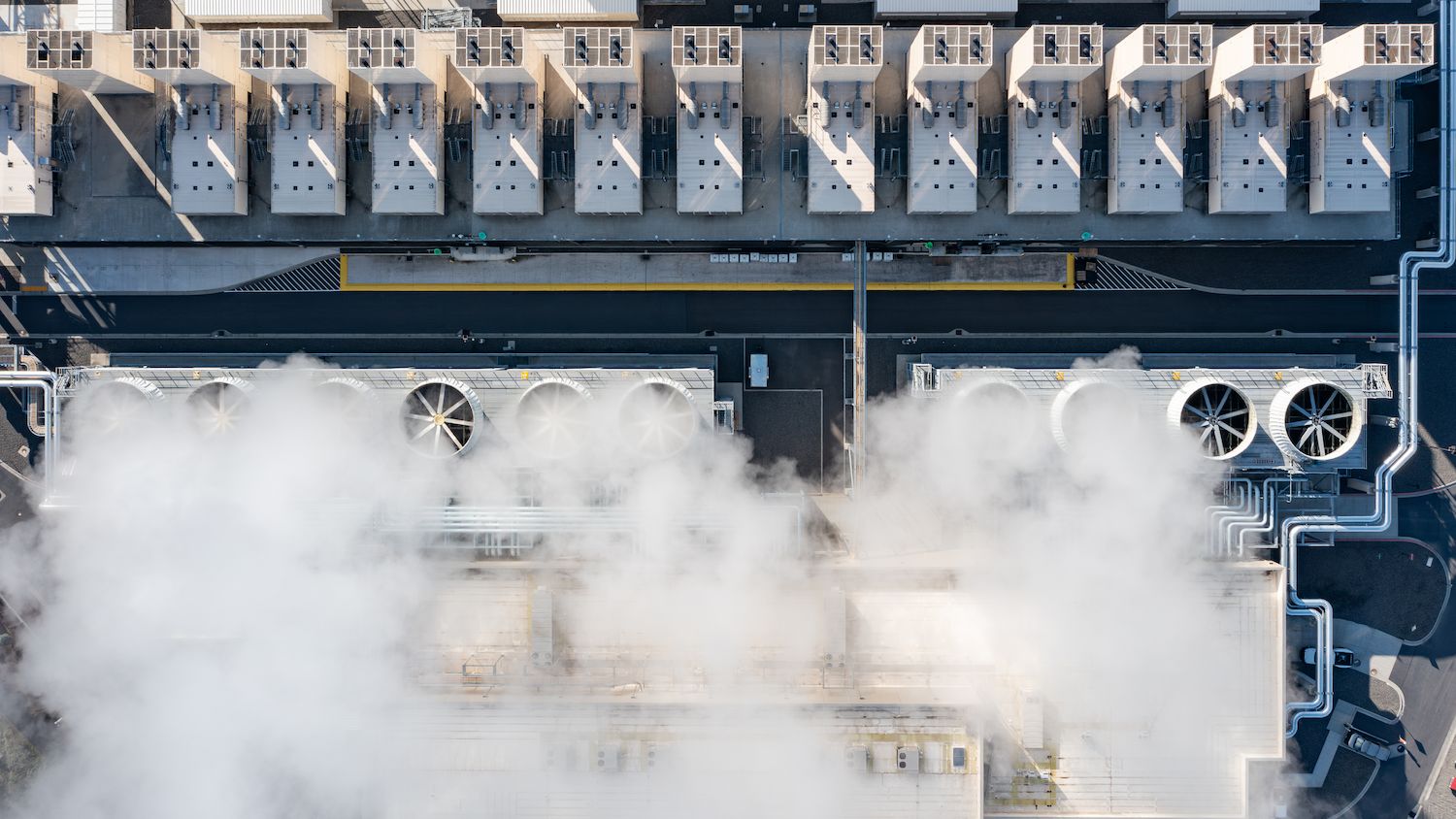
Servers generate heat, and most data centres remove it with water, not just electricity. The dominant method, evaporative cooling, sprays or circulates water over hot surfaces so it evaporates and carries heat away — efficient, but the water is gone for good once it turns to vapour.
Not every facility works this way. Closed-loop systems recirculate the same water indefinitely, and air-cooled designs skip water entirely in favour of fans and chillers. Equinix's San Jose facility uses this air-cooled approach, consuming a fraction of the water an evaporative-cooled facility of the same size would use.
The question isn't how much water AI uses, but where it's drawn from and what it's displacing.
Myth 1: AI Data Centres Drain Local Water Supplies
The claim has a kernel of truth. Research published in Environmental Science & Technology mapped 9,347 data centres worldwide against monthly gaps between renewable water availability and consumption, and found that roughly one in four sit in areas where demand exceeds supply for at least one month a year — 2,315 facilities in water-stressed zones.
But the national picture tells a different story: Lawrence Berkeley National Laboratory's study of US data centre water consumption found that direct water use is a small fraction of total US freshwater withdrawal, nowhere near the scale needed to cause a national crisis. The myth survives on local examples; it collapses under national data.
Myth 2: Data Centres Use More Water Than Golf Courses and Farms
Golf courses make the sharpest comparison. A typical 18-hole course uses 90 to 130 million gallons of water a year (Golf Course Superintendents Association of America), and desert courses use far more — in Palm Springs, a single course can consume over 1 million gallons a day, roughly what a family of four uses in four years.
US data centres used about 17.4 billion gallons directly in 2023 (Lawrence Berkeley National Laboratory). The US has more than 16,000 golf courses; at the low end of the range, golf irrigation alone approaches or exceeds total data centre consumption nationally.
The 'data centres use more water than golf courses' claim does not hold up.
Annual Water Use: Selected US Comparisons
Indicative scale only. Figures are drawn from different years and methodologies, so treat them as orders of magnitude.
Lawrence Berkeley National Laboratory; golf course figures from published regional estimates
Myth 3: All Water Use Is Equal
A gallon is not a gallon. The source of the water, its quality, and whether it returns to the system all change its real-world impact. Freshwater drawn from a stressed aquifer is a very different proposition from reclaimed municipal wastewater running through a closed cooling loop.
Some operators now use reclaimed water — a genuine mitigation. Others draw potable water in dry regions, which is exactly the scenario that generates local opposition. Consumption is also seasonal: the same facility can be harmless in spring and damaging during a summer drought.
Understanding the Types of Water: Blue, Grey, Green and Virtual
Water researchers split usage into categories, and understanding them clarifies most of the debate. Blue water is surface and groundwater — rivers, lakes, aquifers — the category data centre cooling and irrigation compete for directly, and the one behind nearly all local concern.
Grey water measures the freshwater needed to dilute pollutants to safe standards — a pollution indicator, not a withdrawal. Green water is moisture stored in soil, relevant to agriculture but not data centres. Virtual water is the water embedded in a product or service — including the water used to generate the electricity a data centre draws, which is often larger than its direct consumption and almost never counted in headline figures.
Measuring only the gallons a data centre uses on site is like judging a car's pollution by its tailpipe alone.
What real people think
DividedSourced from Reddit, Twitter/X, and community forums
Online discussion is sharply split. Many users repeat the claim that data centres use more water than golf courses or farms, while others push back with national figures. The stronger, more consistent thread concerns local impact and a lack of transparency about where water comes from.
A widely shared analysis of public comments found over 90% of around 10,000 submissions were negative, with water cited as the top concern at many local meetings.
Commenters picked up the finding that one quarter of the world's data centres sit in areas where water demand exceeds supply for at least one month a year, noting that water, unlike electricity, cannot easily be imported from far away.
Users asking how bad the problem is received a mix of answers, with many pointing out that national totals are small but local impacts are real.
Several threads argue golf courses use far more water nationally than data centres, and a number of commenters dismiss the data centre concern as overblown on that basis.
What Reddit is saying
Every thread in this set leans sceptical, with r/science presenting regional water stress research, r/NoStupidQuestions voicing shortage fears, and r/technology reporting strong local opposition to data centres.
Researchers reporting in ACS’ ... water resources and found that, under a future climate scenario, the proportion of facilities in water-stressed areas could rise to one-third....
Read full discussion →Data centers use a crazy amount of water, and it’s only going to get worse with AI growth. ... Reports are coming out that we may start running out of water by late Summer of 2027. I'll see if I
Read full discussion →... Data centers pollute the waters and land and air, they are not needed, AI does not need to take over our world, we must stop hinging our economy on this nonsense that is ultimately a surveillance
Read full discussion →Curated from 3 active threads across r/science, r/NoStupidQuestions, r/technology
What people are saying on X
Critics of the water-myth framing edge out those dismissing the concern, roughly 4:3, with the strongest pushback focused on local aquifer strain and the measurement gap.
The tweets split between those who say the data-centre water concern is largely a myth and those who point to real local impacts. Several posts cite national figures showing direct data-centre water use is a small share of municipal supply, while others stress that closed-loop and offshore designs avoid freshwater use and that local aquifers in places like Morrow County, Oregon, are under real strain. The conversation also turns on measurement difficulty, with one post arguing that voters rejected data centres partly because water impacts are hard to quantify.
Power: ~4.7% of US electricity in 2024 (LBNL), rising toward 5-7% now and projected ~12% by 2030....
The claim that data centers are a large drain on the nation's water does not hold up. Its just false. In 2024, large U.S. data centers consumed an estimated 19–23 billion gallons on site (Han et…
China put a data center under the sea powered by offshore wind and cooled by the ocean. It uses no fresh water.
In Morrow County, eastern Oregon, Amazon Web Services data centers have become part of a growing debate over water quality, public health and environmental protection....
Curated from 12 recent posts using deliberate viewpoint balancing
The Real Numbers: Data Centres vs Agriculture, Golf and Other Industries
At national scale, data centre water use is real but small beside agriculture, and comparable to or below golf irrigation. The reason it gets attention is growth: direct US consumption rose from about 5.6 billion gallons in 2014 to 17.4 billion in 2023 — roughly a threefold increase in nine years (Lawrence Berkeley National Laboratory).
Two caveats matter. First, this figure excludes the water used to generate the electricity data centres draw, which a University of California study estimated can double a facility's true water footprint once power-plant cooling is included. Second, national averages hide local extremes — a facility in water-rich Virginia and one in drought-stricken Arizona are not the same story, even if the national total looks modest.
Key Figures at a Glance
17.4B gallons▲
US direct data centre water use, 2023
5.6B gallons
US direct data centre water use, 2014
2,315
Data centres located in water-stressed areas
~70%
Share of global freshwater withdrawals used by agriculture
Lawrence Berkeley National Laboratory; Rosa et al., Environmental Science & Technology; UN World Water Development Report
Where the Concern Is Legitimate
The objections that hold up are specific, not general. Four stand out: drought regions, where facilities drawing potable water in already-stressed basins genuinely compete with households and farms; evaporative cooling in dry climates, which turns a manageable load into a significant permanent loss; opaque disclosure, since companies report inconsistently and most off-site water use (like power-plant cooling) isn't captured at all; and rapid, concentrated growth, where multiple large facilities cluster in the same basin faster than water authorities can plan for them.
Each of these is a local planning failure, not a national emergency.
The data centre water problem is a planning problem, and it is being solved in the wrong places.
Conclusion: Concerning or Overblown?
The concern is largely overblown as a national story and largely justified as a local one. Data centres use real water, and that use is growing fast — but measured against agriculture and golf courses, the national total is modest, and the claim that AI is draining the country's water supply does not survive the numbers.
Where the concern holds is specific: dry basins, evaporative cooling in hot climates, and facilities sited without regard to local water balance. A single poorly sited facility in Arizona does more local damage than a thousand well-sited ones in Virginia — which is exactly why national statistics miss the real risk.
Further Reading
The primary US government-funded research on how data centres use water and energy, with methodology notes.
Authoritative global figures on how water is divided across agriculture, industry and households.
A plain-language primer on the regulatory and water-use questions around data centres.
A useful thread for seeing how the water-stress research is received and debated by the public.
Sources
- 1.Voters rejected AI data centers over resource concerns. Here's why measuring water usage is hard (CNBC)
- 2.Why Data Centers Use 17.4B Gallons of Water [2026]
- 3.One-Quarter of Data Centers Are Located in Water-Stressed Areas, Study Shows (ScienceAlert)
- 4.How Much Water Do Data Centers Use? Myth vs Reality (2026) (GPUSmith)
- 5.AI's water consumption includes surging demand from electricity use (Los Angeles Times)
- 6.Data Centres and Water Scarcity Risk: New Research (World Economic Forum)
- 7.The water use of data center workloads: A review and assessment of key determinants (Lawrence Berkeley National Laboratory)
- 8.Data Centers and Water Fact Sheet, January 2026 (Environmental Law Institute)
- 9.Why do AI data centers need so much water? (Britannica)
- 10.Agricultural water as a share of total water withdrawals (Our World in Data)
- 11.Widely cited global irrigation statistics lack empirical support (PMC)
- 12.Water Footprint & Water Colors: Blue, Green, Grey & Virtual Water (ResearchGate)
Rate this article
Your feedback helps surface the best content
Related articles
Have a question? Get your own article.
Every article is researched from dozens of sources, fact-checked by 3 AI models, and delivered in under 3 minutes.