China's Viral AI Rap: A Musical Breakthrough or a Cultural Phenomenon?
October 27, 2026 · 3 min read
···
Photo by Gustavo Fring on Pexels
- AI rap 'Guo Lai Ren' is a technical marvel, not an artistic one.
- Its 100M+ views driven by novelty and cultural resonance, not lyrical depth.
- AI excels at mimicry; human artists still lead innovation.
- A proof of concept, not a chart-topping masterpiece.
Key Takeaways
- The AI-generated track 'Guo Lai Ren' achieved over 100 million views, primarily due to its novelty and cultural integration of historical figures.
- Technically, the track features competent production and impressive vocal synthesis, showcasing AI's ability to mimic human delivery.
- Artistically, it lacks the lyrical depth, emotional nuance, and innovative production typically found in acclaimed human-made rap.
- The track highlights AI's current strength in rapid content creation and cultural adaptation, rather than groundbreaking artistic innovation.
The AI Rap Phenomenon: More Than Just a Novelty?
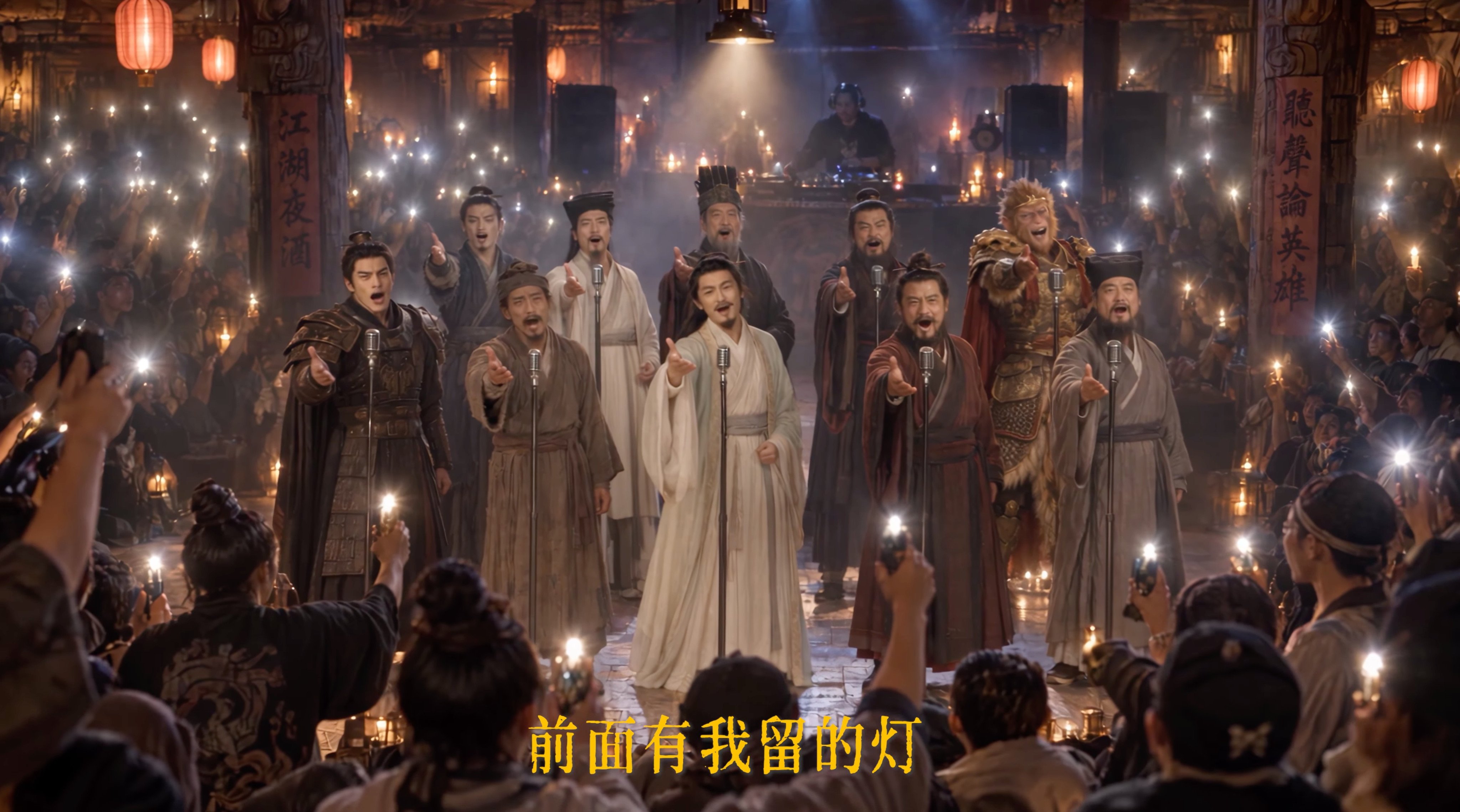
An AI-generated Chinese rap song, "Guo Lai Ren" (The OGs), has exploded across social media, capturing over 100 million views. This viral video, featuring well-known Chinese historical figures rapping, passed 120 million views across Chinese platforms like Douyin by October 22, 2026, according to 21st Century Business Herald.
Its immense popularity has ignited a global conversation about AI's role in creativity and cultural expression. The central question remains: Is "Guo Lai Ren" actually a good rap track, or is its virality driven by other factors?
The primary reason 'Guo Lai Ren' achieved over 100 million views is not its musical brilliance, but rather the sheer novelty of historical figures rapping and the cultural barrier that makes Western audiences less critical of its lyrical content.
AI-Generated Historical Figures
Deconstructing the Sound: Production, Flow, and Synthesis
The production quality of "Guo Lai Ren" is notably competent, featuring a beat with prominent 808s and drums at approximately 90 beats per minute. This provides a solid, genre-appropriate foundation for the track. The AI-generated vocals demonstrate impressive rhythm and cadence, maintaining a consistent flow throughout the verses.
Vocal synthesis technology has advanced significantly, making the voices sound remarkably realistic, though their ability to convey deep, nuanced emotion remains a point of contention. Lyrical structure and rhyme schemes are present, but tend towards functional rather than innovative complexity.
Strengths and Shortcomings: An Honest Appraisal
"Guo Lai Ren" exhibits several clear strengths. The beat and overall production are competent, fitting well within the hip-hop genre. Its vocal synthesis is particularly impressive, effectively mimicking human delivery to create believable performances.
The novelty of historical figures rapping also provides significant cultural resonance, engaging audiences through an unexpected blend of tradition and modernity.
However, the track reveals notable weaknesses when judged against established rap standards. Lyrical depth and originality are limited, often relying on historical references without offering profound contemporary insight. The flow, while technically competent, lacks the spontaneous improvisation and emotional gravitas characteristic of top human rappers.
Ultimately, the artistic vision feels more like a successful technical demonstration of AI's capabilities than a passionate, groundbreaking artistic statement.

Guo Lai Ren Viewership
100 Million+
Views across platforms
120 Million
Views on Chinese platforms by Oct 22, 2026
21st Century Business Herald via Aimusicpreneur.com
Many assume the virality of AI-generated music like 'Guo Lai Ren' signals an immediate threat to human artists, when in reality, it highlights AI's current strength in mimicry and concept execution, not necessarily groundbreaking artistic innovation.
The Engine of Virality: Why 'Guo Lai Ren' Exploded
The immense popularity of "Guo Lai Ren" stems from a confluence of non-musical factors. The primary driver was the sheer novelty of an AI creating a rap track, especially one featuring revered historical figures. This concept alone generated significant "wow" factor and discussion.
The use of well-known Chinese historical figures, such as Zhuge Liang and Cao Cao, deeply resonated with local audiences, tapping into a rich vein of cultural identity.
For global audiences, the Chinese language itself added an exotic element, making immediate critical lyrical analysis less common and fostering curiosity. Furthermore, platforms like Douyin (TikTok China) played a crucial role; their powerful recommendation algorithms amplified the track's reach, leveraging the platform's short-form video trends.
Fundamentally, "Guo Lai Ren" served as a compelling proof of concept for AI's capabilities in creative fields, sparking widespread debate and engagement.
Douyin's Algorithmic Reach
The immediate 'winner' is AI music generation software, demonstrating its potential for rapid content creation and cultural adaptation, while the 'loser' is the traditional critical framework for evaluating music, which struggles to apply artistic standards to novelty-driven AI outputs.
Why This Matters
The phenomenon of "Guo Lai Ren" is a critical turning point, not for music quality, but for the perception of AI's creative potential. It decisively proves that AI can generate technically proficient and culturally resonant content that captures mass attention.
This shifts the conversation from 'can AI create?' to 'how will AI create, and what does it mean for human artistry?' By 2028, AI music generation software will undoubtedly produce commercially viable, chart-topping tracks in niche genres, particularly those valuing formulaic structures. However, it will still struggle to consistently create universally acclaimed, genre-defining works without significant human curation and artistic direction.
The true challenge now lies in evolving our critical frameworks to evaluate AI-generated art, recognizing its unique strengths while still valuing the irreplaceable human elements of innovation, raw emotion, and profound lyrical depth.
What Reddit is saying
r/musicproduction and r/askmusic lean skeptical about AI music quality, while r/rap and r/Music discussions focus more on whether the genre is threatened and on what the artist actually said.
Rap is doing well, nothing is ruining it. ... If everyone jumping on the autotune bandwagon didn’t do it nothing can kill it. Also even if 90% of hip-hop becomes riddled with AI they’re still gonna be
Read full discussion →This music is lifeless and sucks and is worth criticizing. Even if they get the composition side down, the mix is crap, the sounds are pretty rough, it lacks dynamics and expression, etc.
Read full discussion →Who We Be, that’s why he raps “I listened to X, I peeped the bars”. ... Did anyone read the article? I feel like people are just saying the usual “AI sucks” without commenting on anything he’s saying.
Read full discussion →Who does EZ Mil make music for? I only ever see him pop up when Em is on a feature..the feature itself is exactly what I expected - neither good nor bad, it's just more of the same.
Read full discussion →Curated from 6 active threads across r/rap, r/musicproduction, r/Music, r/hiphopheads
What people are saying on X
Almost none of the posts take a position on the track itself, with the small share that does leaning sceptical toward AI-generated music.
The tweets supplied barely touch the question of whether China's viral AI rap track is any good: most are off-topic, referencing unrelated stories such as Indian Army footage, Chinese stock market losses, a game promotion, and a Theranos documentary review. Where music is discussed, the posts concern AI-swapped Tiny Desk performances and a Follow Me video dismissed as obvious AI slop, so no one in this set is making a direct quality judgment on the China track.
⚠️ FACT CHECK: The Indian Army ... of border areas in Arunachal Pradesh! 🚨 Cops & Army confirm AI lip-syncing was used on 2023 J&K operational footage....
ai caralho kkkkkkkkkkkkkkk · geopol•pt · @GeopolPtOct 22 · 🇨🇳🇺🇸📈📉 O mercado bolsista da China desvalorizou mais de 20%, entrando oficialmente....
Log inSign up · しーぼる on X: "AIに聞くと、ちゃんと論文紹介してくれるし、中国語でも翻訳・解説してくれるから技術の進歩を感じる https://t.co/7RfltF531z" · しーぼる · @cvol_D · Show translation · AIに聞くと、ちゃんと論文紹...
JUST IN: China's Communist Party reportedly convenes secret 4-day meeting of its top officials.
Curated from 12 recent posts using deliberate viewpoint balancing
Further Reading
Explores the cultural impact and virality factors of 'Guo Lai Ren'.
Details the viewership numbers and context of the AI rap track.
Discusses the broader implications of AI in music production.
A Reddit discussion on the impact of AI on rap music.
Sources
- 1.100 million views: why China’s viral AI rap track has struck a chord | South China Morning Post
- 2.China's Viral AI Rap Track Hits 100 Million Views
- 3.Guo Lai Ren: China's AI Rap Hits 120 Million Views
- 4.Manila Bulletin - Chinese creator’s rap hit reignites debate on AI-generated music
- 5.Why China's Viral Ai Rap Track Hit 100 Million Views So Fast — Elearning
- 6.Chinese Rap — AI Chinese song (Hip Hop) | SongUp AI
- 7.r/rap on Reddit: Do you agree that AI is Ruining Rap Music Yes or No and Why?
- 8.TikTok - Wikipedia
Rate this article
Your feedback helps surface the best content
Related articles
Have a question? Get your own article.
Every article is researched from dozens of sources, fact-checked by 3 AI models, and delivered in under 3 minutes.
Triple-Verified — 1 correction applied across 3 verification stages applied