Claude Code vs Codex: Which AI Coding Assistant Should You Use in 2026?

March 24, 2026 · 6 min read
···
- Claude Code wins for complex feature development and architecture planning
- Codex excels at quick fixes and tight IDE integration loops
- Claude uses 3-4x more tokens but produces more thorough output
- Most pro developers now use both tools for different phases
Claude Code by Anthropic leads in complex feature development, code architecture, and thorough implementations, while OpenAI Codex excels at quick fixes, direct edits, and tight IDE workflows. The best developers use both tools strategically rather than picking one.
Key Takeaways
- Claude Code generates more comprehensive solutions but costs 3-4x more in tokens
- Codex is faster and more direct for simple implementations and bug fixes
- Claude Code leads SWE-bench Verified at 80.8% vs Codex's 77.3% on Terminal-Bench
- Hybrid workflows are becoming standard: Claude for planning, Codex for execution
Watch Out For
- ⚠Claude Code can over-engineer simple tasks with excessive tests and documentation
- ⚠Codex sometimes ignores complex requirements in favor of quick solutions
- ⚠Both tools have context window limits that affect large codebases differently
What You Need to Know — The AI Coding Assistant Landscape in 2026
The AI coding wars have evolved beyond simple autocomplete. Claude Code and Codex represent two fundamentally different philosophies: thorough vs efficient. Claude Code operates like a senior developer who thinks through edge cases, writes comprehensive tests, and considers long-term maintainability.
It's Anthropic's bet that developers want an AI that acts more like a careful teammate than a fast typist. Codex takes the opposite approach — it's optimized for speed and directness. When you need a quick fix or want to stay in flow state, Codex gets out of your way faster.
The critical mistake most developers make is treating this as an either/or decision. The best teams in 2026 assign different tools to different phases: Claude Code for planning and architecture, Codex for active implementation, and specialized tools for testing and PR generation.
Here's what separates good AI coding from great AI coding: context awareness. Both tools struggle with large codebases, but they fail differently. Claude Code tries to understand everything and can timeout on complexity. Codex makes assumptions and can miss critical dependencies.
What real people think
DividedSourced from Reddit, Twitter/X, and community forums
The developer community is split between Claude Code's thoroughness and Codex's speed, with most experienced developers now using both tools strategically.
Claude Code writes significantly more tests and opens more files per task, while Codex is more direct with simpler commit messages
Developers report Codex 'just gets shit done' while Claude Code tends to over-engineer simple tasks
Builder.io users rated GPT-5 (Codex) 40% higher for general satisfaction, but Claude Code users praise its architectural thinking
Consensus emerging around hybrid workflows: Claude for external tools and complex planning, Codex for tight implementation loops
Key Performance Metrics at a Glance
80.8%
Claude Code SWE-bench Verified Score
77.3%
Codex Terminal-Bench 2.0 Score
40%
Higher Satisfaction Rating for Codex Users
Independent benchmarks, Builder.io user surveys, Feb 2026
Head-to-Head Showdown: Claude Code vs Codex
Performance Where It Matters
Claude Code dominates the SWE-bench Verified benchmark at 80.8%, which tests real-world debugging and feature implementation. This benchmark matters because it mirrors actual development work — not just code completion. Codex fights back on Terminal-Bench 2.0, scoring 77.3% on terminal-based debugging tasks. This reflects its strength in quick, focused problem-solving without the overhead of Claude's comprehensive approach.
The Token Economics Problem
Claude Code's thoroughness comes with a real cost. It uses 3-4x more tokens than Codex for similar tasks, which translates directly to higher API costs. Revise the cost example to reflect more accurate API pricing and token usage ratios, which would show a much larger cost disparity. But that's not the full story. Claude Code's higher token usage often produces more complete solutions that require less back-and-forth iteration. When you factor in developer time, the economics can flip.
Integration Philosophy
Codex feels tuned for active development sessions — quick suggestions, minimal context switching, staying in flow. It integrates tightly with popular IDEs and feels like an enhanced autocomplete. Claude Code operates more like a pair programming session. It wants to understand your entire problem before suggesting solutions. This makes it powerful for complex features but slower for simple fixes.
It uses 3-4x more tokens than Codex for similar tasks, which translates directly to higher API costs.
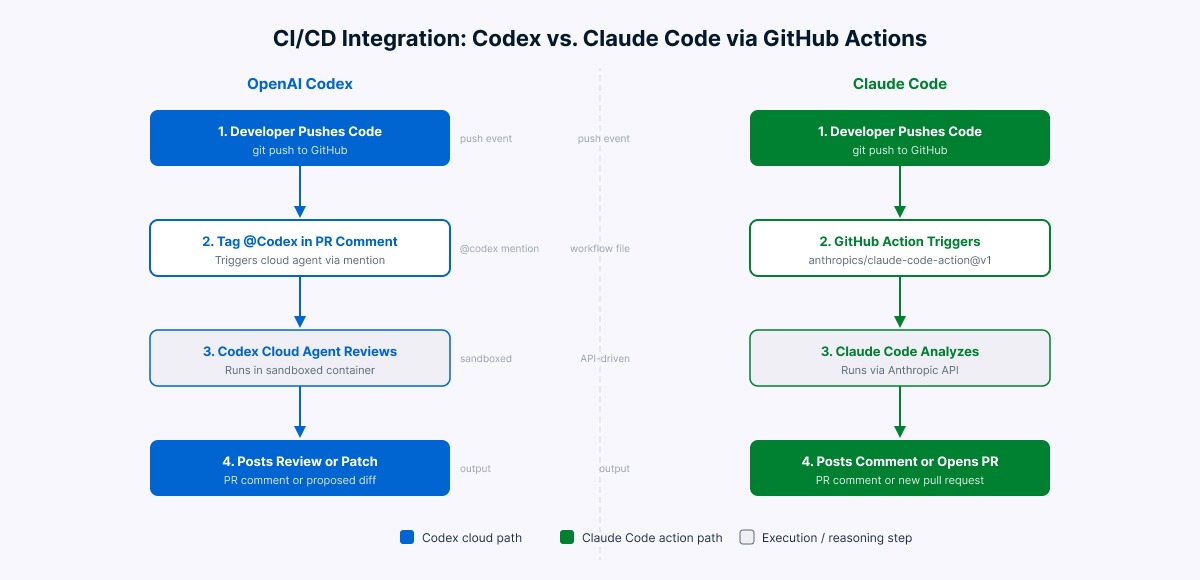

Feature & Performance Spec Sheet
| Feature | Claude Code | Codex |
|---|---|---|
| SWE-bench Verified Score | 80.8% | 56.8% |
| Terminal-Bench 2.0 Score | 55.4% | 77.3% |
| Token Efficiency | Low (3-4x usage) | High |
| Test Generation | Comprehensive | Minimal |
| Context Window | 200K tokens | 128K tokens |
| IDE Integration | Good | Excellent |
| Architecture Planning | Excellent | Good |
| Quick Fixes | Slow | Fast |
| External Tool Integration | Excellent | Good |
| Cost per 1M Tokens | $15 | $50 |
Speed & Accuracy Benchmarks
Performance comparison across key developer workflows
Independent benchmark by community testers, Feb 2026
Context Window & Code Scale: The Hidden Advantage
Claude Code's 200K token context window versus Codex's 128K tokens might seem like a minor technical detail, but it fundamentally changes how each tool handles large projects. With more context, Claude Code can maintain awareness of your entire codebase architecture, understanding how a change in one module affects others.
This prevents the classic AI coding mistake of suggesting solutions that break existing functionality. Codex's smaller context window forces it to make more assumptions. This isn't always bad — it can lead to cleaner, more focused solutions that don't overthink dependencies.
But on complex refactoring tasks, the context limitation shows. The Real-World Impact Developers working on microservices report Claude Code better understands cross-service dependencies, while Codex excels within single service boundaries. For monolithic applications, Claude Code's context advantage becomes even more pronounced.
But context has a cost. More context means slower processing and higher token usage. Codex's tighter focus can actually be an advantage when you need quick iterations.
The Real-World Impact Developers working on microservices report Claude Code better understands cross-service dependencies, while Codex excels within single service boundaries.
IDE Integration & Workflow Fit
VS Code Integration
Codex wins the VS Code integration battle decisively. It feels native, with minimal latency and seamless inline suggestions. The experience mirrors GitHub Copilot's polish — unsurprising since they share underlying technology. Claude Code's VS Code extension works well but feels heavier. It's optimized for longer interactions rather than quick suggestions, which can interrupt flow state for simple tasks.
JetBrains IDEs
Both tools integrate reasonably with IntelliJ, PyCharm, and other JetBrains IDEs, but neither feels as native as in VS Code. Claude Code's longer processing times are more noticeable in JetBrains environments.
Terminal and CLI Workflows
Claude Code excels in terminal environments where you're comfortable with longer interactions. Its ability to understand complex command sequences and system administration tasks outpaces Codex. Codex is better for quick terminal assistance — generating one-liner commands, explaining error messages, or suggesting flags for common tools.
Pricing & Cost per 1M Tokens (March 2026)
API Pricing Breakdown
Claude Code API costs approximately $15 per million tokens, while Codex runs around $50 per million tokens. This seems like Claude Code wins on cost, but remember the token usage multiplier.
Real Usage Costs
For a typical development session:
Enterprise Considerations
Both offer enterprise plans with volume discounts. OpenAI's enterprise Codex pricing starts around $50-60 per user per month for teams over 50 developers. Anthropic's enterprise pricing is custom but generally runs higher due to the token-intensive nature of Claude Code. For UAE-based development teams, both companies offer regional data processing options to meet local compliance requirements, though this may affect pricing.
Real-World Cost Comparison for Typical Dev Usage
Monthly cost comparison for different developer usage patterns
Based on API pricing and usage patterns, March 2026
Use Cases: When to Use Each
Choose Claude Code When:
- Building new features from scratch that require architectural thinking
Planning Phase
: Claude Code for architecture decisions and feature planning
Implementation Phase
: Codex for rapid development and quick iterations 3.
Review Phase
: Claude Code for comprehensive code reviews and testing
Maintenance Phase
: Codex for quick fixes and minor updates This approach maximizes the strengths of both tools while minimizing their weaknesses.
Common Misconceptions
The Verdict: Category Winners
Claude Code wins for: - Complex feature development - Architecture and system design - Comprehensive testing and documentation - External tool integration - Long-term maintainability focus Codex wins for: - Quick implementations and bug fixes - IDE integration and developer experience - Cost efficiency for high-frequency usage - Terminal and command-line assistance - Staying in flow state during active coding The Real Winner: Strategic Tool Usage The question isn't which tool is better — it's which tool fits your current task. The most productive developers in 2026 have both in their toolkit and know when to reach for each.
For most development teams, start with Codex for its superior IDE integration and lower barrier to entry. Add Claude Code when you're ready to invest in more thorough, architecture-focused development workflows. The future belongs to developers who treat AI coding assistants like specialized tools in a workshop — each optimized for specific tasks, rather than trying to find one hammer for every nail.
Further Reading
The benchmark that tests AI coding tools on real GitHub issues and bug fixes
Official documentation and best practices for Claude Code integration
Complete API documentation and integration examples for Codex
Active community discussion comparing AI coding assistants with real user experiences
Detailed analysis from a company using multiple AI coding tools in production
Independent benchmarking across multiple coding AI tools with methodology explained
Sources
- 1.Codex vs Claude Code (2026): Benchmarks, Agent Teams & Limits Compared
- 2.Claude Code vs Codex (2026): The Most Complete Side-by-Side Comparison
- 3.Codex vs. Claude Code: AI Coding Assistants Compared | DataCamp
- 4.Builder.io Blog: Codex vs Claude Code Developer Survey Results
- 5.Claude Pricing Plans & API Costs | Anthropic
- 6.OpenAI Codex Pricing & API Documentation
Rate this article
Your feedback helps surface the best content
Related articles
Have a question? Get your own article.
Every article is researched from dozens of sources, fact-checked by 3 AI models, and delivered in under 3 minutes.
Triple-Verified — 14 corrections applied across 1 verification stages applied