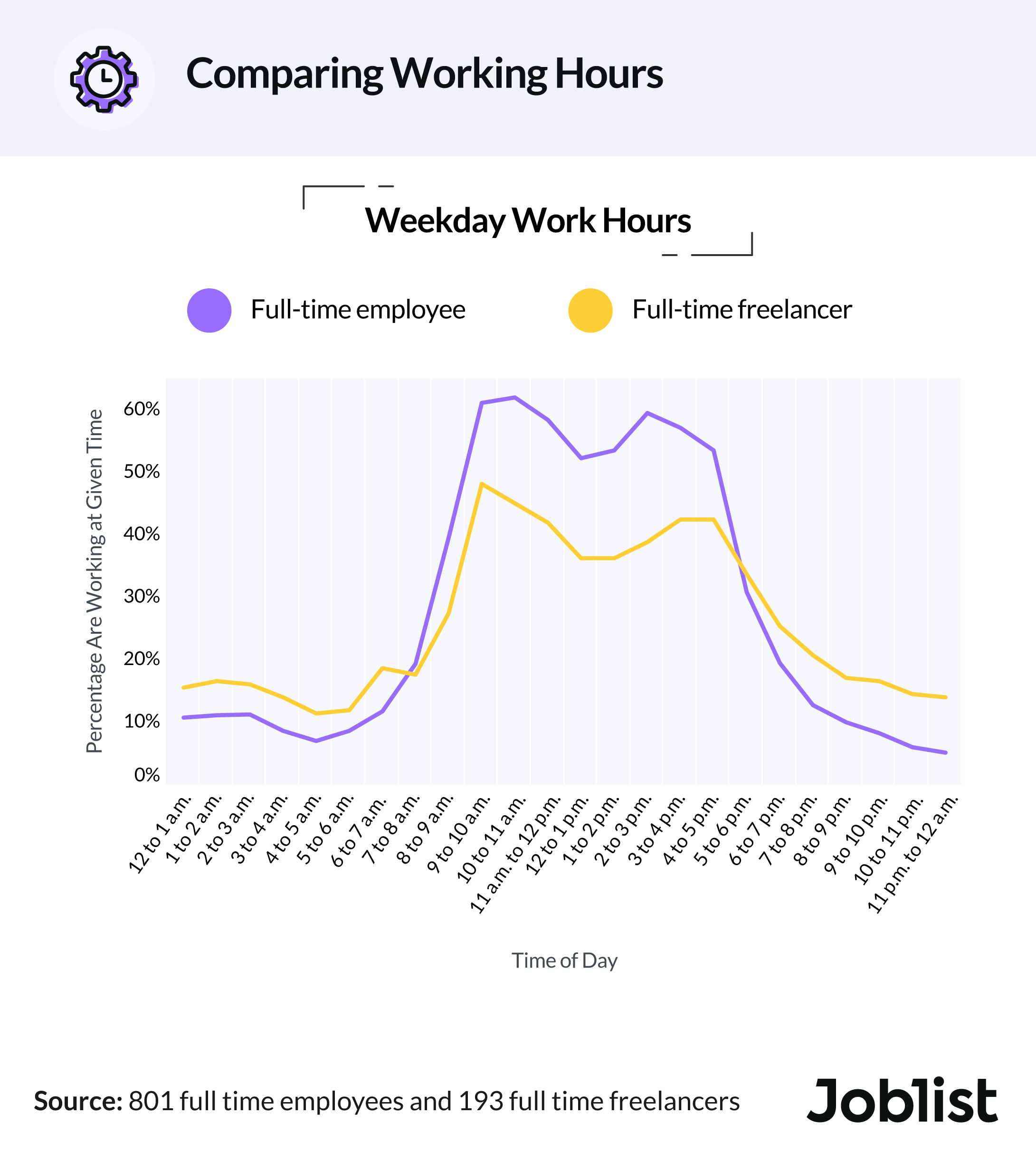
- Freelancing can net 20-40% more take-home pay than equivalent full-time roles
- but only if you charge correctly and maintain consistent client flow
- The break-even point is charging $70/hour for a role equivalent to $100k salary.
A freelancer needs to earn $140k gross to match the take-home pay of a $100k full-time employee after accounting for taxes, benefits, and hidden costs. However, skilled freelancers typically charge 15-30% more than this break-even rate, resulting in 20-40% higher take-home pay.
Key Takeaways
- Freelancers pay 15.3% self-employment tax that employees don't
- Full-time benefits are worth $20k-$30k annually on average
- Break-even freelance rate for $100k salary job is $70/hour
- Successful freelancers typically charge $75-$125/hour for equivalent roles
- Income volatility is freelancing's biggest hidden cost
Watch Out For
- ⚠Undercharging to 'win' clients destroys your financial advantage
- ⚠Quarterly tax payments require disciplined cash flow management
- ⚠Healthcare costs can eat 10-15% of freelance income
- ⚠Client payment delays create cashflow gaps
What You Need to Know About True Compensation
The freelance vs full-time debate gets clouded by surface-level salary comparisons that ignore the financial reality. A freelancer would have to make $140k (charge $70/hr) to take home the same amount as an employee with a $100k salary. You would need to make $140k to take home $98k for the year as a freelancer.
This isn't speculation—it's math. Freelancers pay 15.3% self-employment tax covering both employee and employer portions of Social Security and Medicare. Self-employment taxes are 15.3% of net earnings in 2024 and cover the FICA taxes (Social Security and Medicare) that businesses automatically withhold from W-2 employee paychecks.
Meanwhile, employee benefits typically add 30–40% on top of base salary. For many U.S. employers, that translates to $20,000–$30,000 per employee per year, depending on wages, company size, and benefit mix. Most people drastically underestimate what their employer actually spends on them beyond salary.
The comparison isn't "$100k salary vs $100k freelance income." It's "$100k + $25k benefits vs $140k freelance gross income." Once you frame it correctly, the decision becomes clearer.
What real people think
Mixed opinionsSourced from Reddit, Twitter/X, and community forums
The online consensus is split between those who've successfully made the transition and earned more, and those who warn about the hidden costs and instability. Most successful freelancers emphasize that pricing correctly from the start is crucial.
High-earning freelancers report doubling their corporate salaries, with some charging $120+ per hour after building expertise and reputation
Common theme of undercharging early in freelance careers, with many reporting it took 2-3 years to match their previous full-time take-home pay
Freelancers report earning more on average ($93/hour vs $72/hour for employees) but also higher stress levels and income volatility
The Numbers That Matter Most
15.3%
Self-employment tax rate
$70/hr
Break-even freelance rate for $100k job
BLS, IRS, freelancer surveys 2024
The Full-Time Package Breakdown
Full-time employment comes with a hidden compensation package that most people never calculate. Here's what a $100k salary employee actually receives: Health Insurance: Employers paid 83% of the $7,739 premium last year for single coverage and 73% of the $22,221 premium for family coverage.
For family coverage, that's $16,221 in employer contribution—money you'd have to earn and pay taxes on as a freelancer.
Retirement Benefits:
Among the most common matches are 50% of the first 6% of salary the worker contributes, or a dollar-for-dollar match of 3% to 6% of pay. On a $100k salary, that's $3,000-$6,000 in free money annually.
Paid Time Off:
That's 7.7% of the full work year, which means right off the bat, your full-time employee will be paid for 7.7% of the work year while out of the office. At an annual salary of $150,000, that's $11,550 going to vacation and sick time. Scale this to $100k and you're looking at $7,700 in paid non-working time.
Other Benefits:
Life insurance ($100-$300), disability insurance ($250-$1,500), and various perks add another $1,000-$3,000 annually.
Total Package Value:
A $100k salary job delivers $125k-$135k in total compensation value. To match this as a freelancer, you need to gross significantly more due to self-employment taxes and the need to self-fund all benefits.
The Freelance Reality Check
Freelancing promises unlimited earning potential, but the financial reality is more nuanced. While the freelancers we surveyed reported earning more, on average — on an hourly basis ($93) and annual basis ($172,028) — compared to full-time employees ($72 and $159,840, respectively), their income arrives pre-tax.
Self-employment tax acts differently, as self-employed individuals are taxed as both an employee and an employer. The tax burden hits harder than most expect. For example, a freelancer earning $100,000 in net self-employment income owes approximately $14,130 in self-employment tax alone—before income tax.
Add federal income tax and the total tax liability reaches $25,000-$35,000 depending on deductions and filing status. The Pricing Reality: In reality a person making a $100k salary, would likely charge more than $70/hr as a freelancer. My baseless estimate would be $75/hr at minimum and $125/hr at the maximum.
At $90/hr for 50 weeks, a freelancer would gross $180k for the year, and take home $128,560. That's a ~$30k pay raise from being a $100k employee. But here's the catch: achieving consistent $90/hour billing requires expertise, reputation, and business development skills that take time to build.
At the peak of my career as an employee, I could expect $7k in net income to hit my bank account on the same day every month—like clockwork. I could also expect to spend 50 to 60 hours most weeks for it. At the peak of my career as a freelancer, I had about $14k in gross income hit my bank account one month.
After setting some aside for taxes and operating expenses, I pocketed less than $7k per month during that two-month period.
The Pricing Reality: In reality a person making a $100k salary, would likely charge more than $70/hr as a freelancer.
Your Personal Take-Home Calculator
Calculate the real financial difference between freelancing and full-time employment based on your specific situation.
$75,000
Full-time take-home (with benefits)
$-6,233
Freelance take-home (after taxes & insurance)
$-81,233
Annual difference
Based on 2024 tax rates and benefit costs
Side-by-Side Financial Breakdown ($100k Equivalent)
| Category | Full-Time Employee | Freelancer ($70/hr) | Freelancer ($90/hr) |
|---|---|---|---|
| Gross Income | $100,000 | $140,000 | $180,000 |
| Federal Income Tax | $15,104 | $14,550 | $26,832 |
| Self-Employment Tax | — | $19,763 | $25,434 |
| Employee FICA | $7,650 | — | — |
| Health Insurance (employer paid) | $16,221 | — | — |
| Health Insurance (self-paid) | — | $7,800 | $7,800 |
| 401k Match | $3,500 | — | — |
| Paid Time Off Value | $7,700 | — | — |
| Other Benefits | $2,000 | — | — |
| **Net Take-Home** | **$98,067** | **$97,887** | **$119,934** |
| Take-home advantage | — | **Break-even** | **+$21,867** |
Take-Home Pay Scenarios by Income Level
Comparison of actual take-home pay between full-time and freelance work at different income levels
Based on 2024 tax rates and average benefit costs
The Hidden Costs Everyone Forgets
Beyond taxes and benefits, freelancing carries operational costs that erode your advantage if not properly accounted for: Business Development Time: A client only pays a freelancer for the hours actually worked. If the freelance developer is sick or on vacation, they do not receive any money.
The employee, on the other hand, receives a fixed salary, even if they are not working at the time. For example, if we assume 28 days of vacation and 15 days of sick leave, that's already 43 days or 344 hours for which they are paid without working. But the difference is even bigger: no full-time employee is productive for eight hours a day.
This analysis reveals a crucial point: as a freelancer, you must account for non-billable time. If you only bill 30 hours per week but work 40 hours (spending 10 hours on business development, administration, etc.), your effective hourly rate drops by 25%.
Cash Flow Gaps:
The unpredictable lag between when I sent an invoice and when I actually got the money meant I got paid like clockwork—in a Salvador Dalí painting. Net-30 payment terms mean you're essentially providing interest-free loans to clients.
Equipment and Software:
Full-time employees get laptops, software licenses, and office space provided. With office space averaging between $300-$1,230 per month and per employee, we are spending anywhere from $3,600 to $14,760 per full-time hire for the whole year. Even companies that have gone remote or are embracing a hybrid policy still spend money on their employees' equipment. As a freelancer, these are your costs.
Professional Development:
Freelance developers proactively monitor new trends and often learn those skills independently. Full-time developers, in comparison, can receive ongoing training through their company. They often complete this training with other team members, where they can ask questions to help one another understand the new concepts. The financial advantage of freelancing assumes you're pricing these hidden costs into your rates. Most new freelancers don't.
the difference is even bigger: no full-time employee is productive for eight hours a day.
Benefits Value by Career Stage
How the relative value of full-time benefits changes based on your life situation
| Metric | Single, 25-30 | Married, no kids | Family with children | Pre-retirement (55+) |
|---|---|---|---|---|
| Health Insurance Value | 6/10 | 7/10 | 9/10 | 9/10 |
| 401k Match Value | 7/10 | 8/10 | 8/10 | 9/10 |
| Paid Time Off Value | 8/10 | 8/10 | 9/10 | 7/10 |
| Job Security Premium | 5/10 | 7/10 | 9/10 | 8/10 |
| Income Volatility Tolerance | 9/10 | 7/10 | 4/10 | 3/10 |
When Freelancing Actually Costs You Money
Who Should Choose Each Path
Risk-tolerant high performers
Freelancing if you can charge $90+/hour consistently. The 20-40% take-home premium rewards the risk and hustle.
Families with young children
Full-time employment. Health insurance alone can save $15k+ annually, and income predictability matters more with dependents.
Early career professionals
Full-time first to build skills and network, then transition to freelancing once you can command premium rates.
Pre-retirement workers (50+)
Full-time for healthcare continuity and 401k catch-up contributions, unless you're already an established freelancer.

Sources
- 1.Self-Employment Tax Calculator: Freelancer Tax Guide (2025) - Practical Web Tools
- 2.Making $100k As An Employee Versus Being Self-Employed | Caleb Porzio
- 3.Survey: Do Freelancers Have Better Work-Life Balance? | Joblist
- 4.Average Cost of Benefits per Employee | Selerix
- 5.What Are Your Employee Benefits Really Worth? | NerdWallet
Rate this article
Your feedback helps surface the best content
Related articles
Have a question? Get your own article.
Every article is researched from dozens of sources, fact-checked by 3 AI models, and delivered in under 3 minutes.