Humanoid Robots in 2036: Work, Home, and Society Transformed

April 1, 2026 · 8 min read
···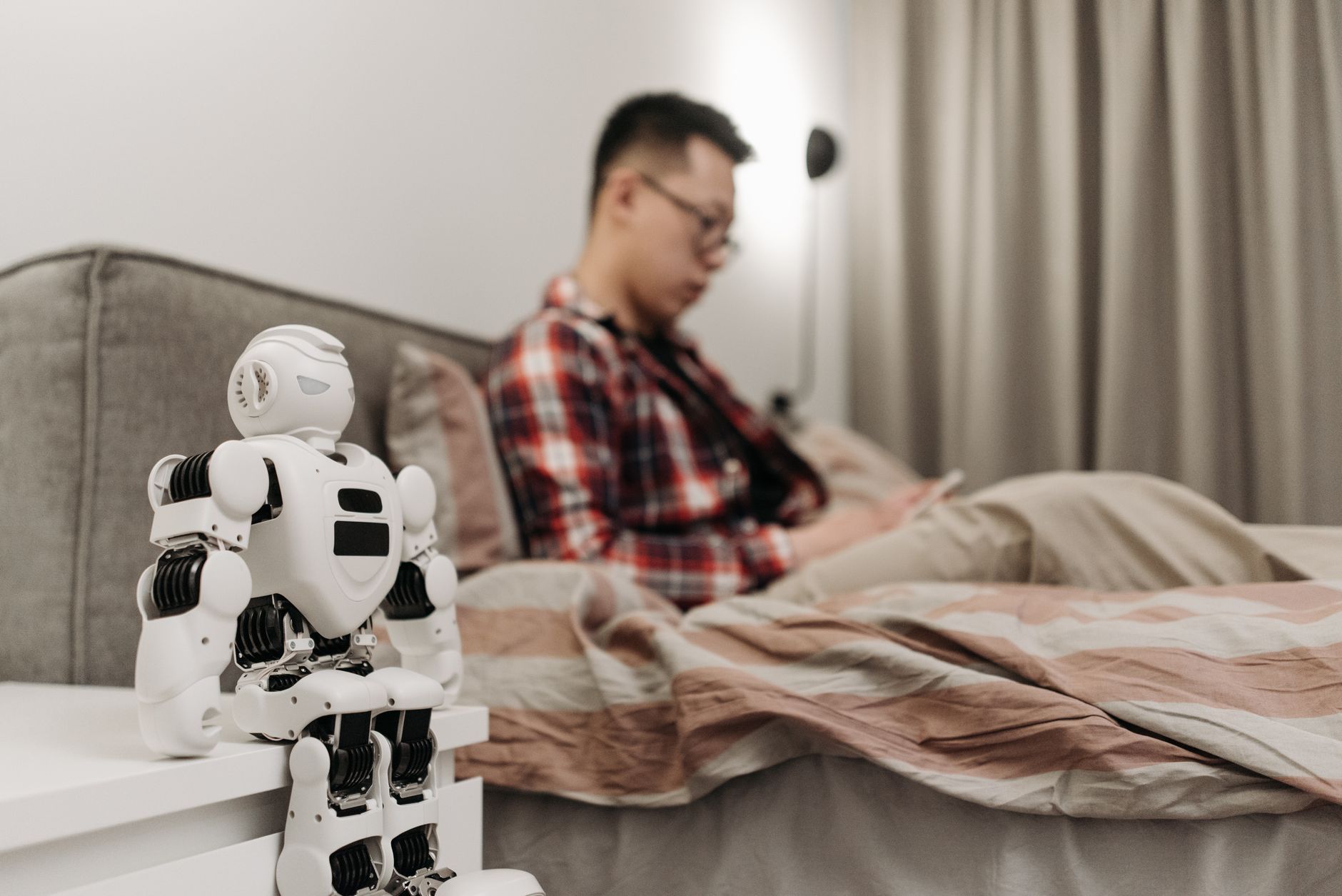
Photo by Pavel Danilyuk on Pexels
- Widespread humanoid robot ubiquity by 2036 is overhyped.
- Industrial deployment is accelerating, not consumer adoption.
- Home robots face significant cost, technical, and safety hurdles.
- Labor impacts will be profound, but delayed and uneven.
The prediction of ubiquitous humanoid robots by 2036, fulfilling all domestic and industrial labor needs, is largely overhyped. While industrial deployment is accelerating, consumer adoption faces significant cost, technical, and social barriers. The trajectory suggests a more gradual, uneven integration, with profound but delayed impacts on labor and society, rather than a sudden, all-encompassing transformation.
Key Takeaways
- Industrial and logistics sectors will see early, targeted humanoid robot adoption due to controlled environments and clear ROI.
- Consumer-grade 'robot butlers' for homes by 2036 are highly improbable due to cost, dexterity, and safety challenges.
- The economic impact of 'cheap labor' robots will reshape industries, but widespread $2/hour labor is not a near-term reality.
- Governmental deployment of robot swarms raises significant ethical and power concentration concerns, with limited non-military applications currently defined.
Watch Out For
- ⚠Overly optimistic timelines from manufacturers, particularly regarding consumer availability and price points.
- ⚠The conflation of industrial automation with general-purpose home robotics, which are distinct challenges.
- ⚠Unrealistic expectations about the speed of societal adaptation to widespread automation and labor displacement.
Will the Colorado Avalanche win the 2026 NHL Stanley Cup?
probability of no
20%
80%
Will Jesus Christ return before GTA VI?
probability of no
49%
52%
Will bitcoin hit $1m before GTA VI?
probability of no
49%
51%
Search interest: “humanoid robots”
vs prior 3 months
The Home in 2036: Robot Butlers and Automation Reality
The popular vision of 2036 includes humanoid robots seamlessly performing domestic tasks: laundry, cooking, emptying dishwashers, and general chores. This 'robot butler' fantasy, however, remains significantly out of reach for widespread consumer adoption within a decade.
Current humanoid robots, while impressive in controlled environments, struggle with the unpredictable, unstructured nature of a typical home.
Technical hurdles are immense. Achieving human-level dexterity for delicate tasks, navigating complex and changing layouts without error, and ensuring absolute safety around children and pets are unsolved problems. The current generation of robots like Boston Dynamics Atlas and Tesla Optimus are still in pilot phases, primarily in industrial settings where tasks are repetitive and environments are structured.
Cost presents another formidable barrier. While pricing data is conflicted, The estimated price range for Tesla Optimus is likely significantly lower than stated, with Musk targeting under $20,000. The article should reflect this more competitive pricing landscape., with Clarify that the $13,500 price point refers to the Unitree G1, and Atlas is at the higher end of the range, or provide a more accurate range solely for Atlas if available..
These figures are prohibitive for individual consumers, making the idea of a personal robot butler by 2036 a luxury for the ultra-wealthy, not a ubiquitous reality.
The Economy at $2/Hour Labour: Corporate Competitiveness Reshuffled
The economic promise of humanoid robots lies in their potential to offer 'effectively free labor,' driving down operational costs and reshaping corporate competitiveness. Businesses are indeed poised to deploy these robots in manufacturing, logistics, and other labor-intensive sectors.
Boston Dynamics' Atlas units are already shipping to commercial partners like Hyundai and Google DeepMind in 2026, with all units committed.
This industrial deployment focuses on tasks that are repetitive, dangerous, or require heavy lifting, where the 'cost per hour' calculation offers a clear return on investment. Update the 2026 production target for Tesla Optimus to reflect the more ambitious goal of 1 million units annually by year-end., while Chinese manufacturer BYD aims for 1,500 humanoids in 2025, ramping to 20,000 by 2026.
This aggressive scaling indicates a clear corporate drive for automation.
Industries like automotive, warehousing, and heavy manufacturing will be the earliest beneficiaries, gaining significant competitive advantages through reduced labor costs and increased efficiency. While the notion of $2/hour labor is a powerful economic driver, it's crucial to acknowledge that this refers to the operational cost of the robot over its lifespan, not a direct wage.
The initial capital expenditure remains substantial, and the transition will be gradual, not instantaneous.
Government Power at Scale: When States Have Robot Swarms
The idea of governments wielding 'swarms of robots' at effectively $1 an hour evokes historical parallels to eras of state-controlled labor, such as the construction of the pyramids. In 2036, this could manifest in various non-military applications: large-scale infrastructure repair, rapid disaster response, and extensive public works projects.
Such widespread governmental robot deployment could concentrate immense power in the hands of states, enabling projects of unprecedented scale without the traditional constraints of human labor costs or availability. This scenario bypasses modern labor economics, where wages, benefits, and worker rights are fundamental.
The ethical and regulatory challenges are profound, touching on issues of control, accountability, and the potential for misuse.
The International Federation of Robotics (IFR) emphasizes the need for systems capable of operating seamlessly in human environments with human-like cognition. While the IFR is not opposed to military use of AI or robotics for non-weaponized applications like explosive ordnance disposal, the deployment of vast, state-controlled robot workforces for other purposes raises complex questions about societal structure and individual freedoms.
The Historical Parallel: Free Labour and Its Consequences
The analogy to 'free labor' and the building of the pyramids is stark, drawing attention to the potential for extreme labor cost reduction. Historically, societies built on 'free labor' (such as slavery) often experienced immense wealth concentration, severe social stratification, and inherent instability.
While modern humanoid robots are not sentient beings, the economic impact of 'effectively free' labor could mirror some of these historical consequences.
Such a shift could exacerbate existing inequalities, creating a vast chasm between those who own and control the means of automated production and those whose labor has been devalued. The question arises: are we inadvertently repeating patterns where a significant portion of the population becomes economically superfluous? This is not a direct equivalence to historical slavery, but rather a cautionary examination of the power dynamics and societal structures that emerge when labor costs approach zero.
The long-term societal consequences of such a transformation are difficult to predict, but history suggests that extreme imbalances in labor value can lead to social unrest, political upheaval, and a redefinition of citizenship itself. Understanding these historical parallels is crucial for navigating the ethical landscape of an increasingly automated future.
Humanoid Robots in Industrial Settings

The Path to Ubiquity: 2026 to 2036
Tesla Optimus Production Target
Tesla aims for 5,000 Optimus units, with plans to scale significantly by 2026. This target has faced skepticism due to past missed predictions.
Boston Dynamics Atlas Commercial Shipments
Atlas production units are shipping to commercial partners (Hyundai, Google DeepMind). All 2026 units are already committed, marking a significant industrial milestone.
BYD Humanoid Production Target
Chinese manufacturer BYD aims for 20,000 humanoid units, indicating aggressive scaling in the Asian market.
Atlas Commercial Launch Phase
Boston Dynamics plans broader commercial launch for Atlas, expanding beyond initial partners to additional enterprise customers.
McKinsey Automation Impact
McKinsey Global Institute projects AI could automate up to 30% of hours worked across the U.S. economy, impacting 400-800 million workers globally.
Household Robot Market Growth
The household robot market is projected to reach $95.1 billion, driven by specialized cleaning and assistance robots, not necessarily general-purpose humanoids.
Humanoid Robot Market Projection
The humanoid robot market could reach nearly $30 billion, primarily driven by automotive and logistics deployments, not widespread consumer adoption.
Projected Humanoid Robot Production (2025-2026)
Humanoid Robots Global Market Report 2026-2040
Key Predictions by Sector
$95.1 Billion
Household Robot Market by 2033
$30 Billion
Humanoid Robot Market by 2036
McKinsey Global Institute, IEN, Humanoid Robot Cost 2026
What Could Go Wrong: Risks and Uncertainties
The path to widespread humanoid robot ubiquity is fraught with significant risks and uncertainties that could derail or significantly alter current predictions. The most immediate concern is cost. Despite aggressive production targets, the price points for advanced humanoids like Atlas and Optimus remain prohibitively high for mass consumer adoption.
If prices do not drop dramatically, ubiquity in homes will remain a distant dream.
Technical plateaus pose another threat. Current AI capabilities, while impressive, still struggle with the nuanced decision-making, fine motor control, and real-world adaptability required for complex domestic or unstructured industrial tasks. Battery life, robust navigation in dynamic environments, and seamless human-robot interaction are all areas requiring substantial breakthroughs.
Furthermore, the energy demands of a truly ubiquitous robot fleet could be immense, straining existing power grids.
Regulatory backlash and ethical concerns are also looming. Questions of safety, privacy (especially with robots in homes), and the moral implications of widespread labor displacement could lead to restrictive legislation. Supply chain bottlenecks, particularly for specialized components and rare earth materials, could also hinder manufacturing scale.
The current research often lacks real-world performance data from diverse environments, leaving significant gaps in understanding true capabilities and limitations.
The Unseen Hurdles to Robot Ubiquity
What Happens to Human Work?
The most profound and uncomfortable question surrounding humanoid robot ubiquity is the fate of human work. McKinsey Global Institute predicts that AI could automate 15-30% of the global workforce by 2030, impacting hundreds of millions of workers. This displacement will not be uniform, affecting manufacturing, logistics, and service sectors most acutely.
While some argue that new job categories will emerge, historical evidence suggests that the reabsorption of displaced workers is often slow and uneven, requiring significant retraining and societal adaptation. The effectiveness of current retraining programs is debatable, and the scale of future displacement could overwhelm existing support structures.
This raises the critical debate around Universal Basic Income (UBI) as a potential societal safety net.
A redefined 'social contract' may become necessary, shifting the focus from full employment to meaningful engagement and equitable distribution of automated wealth. The transition will likely be messy, creating significant social and economic friction before any new equilibrium is found.
Ignoring the potential for widespread job loss and its societal implications is a dangerous oversight in any discussion of robot ubiquity.
Human-Robot Interaction in the Future

What real people think
Mixed opinionsSourced from Reddit, Twitter/X, and community forums
Online communities express cautious excitement about humanoid robots but are highly skeptical of near-term ubiquity, especially for consumer use. Practical utility, affordability, and the credibility of manufacturer timelines are major concerns, often outweighing immediate fears of labor displacement.
“So it basically boils down to a bunch of things around what is the cost of labour. As soon as the labour gets displaced, you start a race to the bottom when people are despairing for jobs.”
Reddit user
“Still waiting for Optimus to actually do something useful. Otherwise, it's just a very expensive paperweight.”
Reddit user
Many users are skeptical of the rapid timelines, especially from Tesla, citing past unfulfilled promises. There's a strong focus on practical utility and whether these robots can actually perform complex tasks reliably.
The robotics community appreciates the engineering progress of robots like Atlas but remains grounded in the technical challenges. They emphasize that industrial deployment is a different beast than home use.
Concerns about labor displacement are present, but often framed in terms of a 'race to the bottom' for wages rather than outright job elimination. There's a sense that the economic impact is inevitable but its exact form is debated.
Related discussions
30% of the worlds workforce will lose their job to AI within 7 years
r/ArtificialInteligenceWill humanoid robotics take off?
r/roboticsDoes anyone have a theory about what the future will look like after hundreds of millions of workers around the world are replaced by autonomous humaniod robots?
r/Futurology‘EV moment’ for humanoid robots may be 5 years away, UBS says - Global humanoid robot population will surpass 300 million by 2025, with annual demand reaching 86 million units, Swiss bank says
r/FuturologyFurther Reading
McKinsey's comprehensive analysis of AI's impact on global labor markets and job displacement.
An industry perspective on the technical and commercial trajectory of robotics, including humanoids.
A deep dive into the ethical considerations and societal implications of intelligent autonomous systems.
Academic research on the economic effects of automation, including historical context and future projections.
Sources
- 1.Humanoid Robot Market Could Reach Nearly $30 Billion by 2036 as Automotive, Logistics Deployments Scale
- 2.Humanoid Robots Global Market Report 2026-2040, with Detailed Profiles of Leading Humanoid Robot Manufacturers and Technology Developers
- 3.The Global Humanoid Robots Market 2026-2036
- 4.Tesla robot price in 2026: Everything you need to know about Optimus - Standard Bots
- 5.Tesla Optimus: Complete Analysis of AI, Specs & Future Outlook (2026)
- 6.Boston Dynamics beats Tesla to the humanoid robot punch • The Register
- 7.Boston Dynamics Atlas Robot That Beat Tesla To The Factory Floor
- 8.Humanoid Robot Cost 2026: Complete Price & ROI Breakdown
- 9.AI: Work partnerships between people, agents, and robots | McKinsey
Rate this article
Your feedback helps surface the best content
Related articles
Have a question? Get your own article.
Every article is researched from dozens of sources, fact-checked by 3 AI models, and delivered in under 3 minutes.
Triple-Verified — 6 corrections applied across 2 verification stages applied