Humanoid Robots vs Specialized Task Robots: Which Design Philosophy Wins?

March 20, 2026 · 10 min read
··
- Specialized robots dominate today's industrial applications with 5-20x better speed and efficiency at single tasks, but humanoid robots win in unstructured environments requiring task versatility. Choose specialized if you can design workflows around robots
- choose humanoids if robots must adapt to existing human spaces.
Specialized task robots currently deliver superior ROI for structured manufacturing and logistics environments, completing specific tasks 5-20 times faster than humanoids at a fraction of the cost ($25,000-$200,000 vs $90,000-$250,000). However, humanoid robots are rapidly closing the gap in versatility, with costs dropping 40% between 2022-2024 and the ability to work in existing human infrastructure without expensive facility redesigns. The winner depends entirely on your environment: if you can redesign workflows around automation, specialized robots dominate. If you need robots to navigate stairs, doorways, and unpredictable tasks in brownfield facilities, humanoids justify their premium.
Key Takeaways
- Specialized robots complete single tasks 5-20x faster than humanoids and cost significantly less for fixed operations
- Humanoid robot costs dropped 40% from 2022-2024, with entry models now starting at $13,500
- Humanoids work at 70-85% of human speed for picking tasks, compared to specialized robots that exceed human performance
- Specialized robots dominate 97% of the current industrial market; humanoids represent just 3%
- Humanoids excel in brownfield deployments—no need to redesign facilities, unlike specialized automation requiring extensive infrastructure changes
Watch Out For
- ⚠Humanoid robots are still mostly in pilot phase—fewer than 100 deployed in commercial warehouses as of early 2025
- ⚠Battery life remains a critical bottleneck: most humanoids operate only 2 hours before recharging, compared to 8+ hour human shifts
- ⚠Specialized robots require costly facility redesigns and fixed installations—not suitable for frequently changing tasks
- ⚠Humanoid robot autonomy is limited despite 'general-purpose' marketing—task switching still requires significant retraining
The Robot Divide: By The Numbers
40%▼
Cost reduction in humanoid robots (2022-2024)
$13,500
Entry price for commercial humanoid robots (Unitree G1)
Bain & Company 2025, Robozaps, IDTechEx
The Fundamental Design Tradeoff
The debate between humanoid and specialized robots comes down to a simple engineering question: optimize for one task brilliantly, or handle many tasks adequately?
Specialized robots—industrial arms, SCARA systems, delta robots, automated guided vehicles—are purpose-built machines. A welding robot arm is faster, more precise, and more reliable at welding than any human or humanoid will ever be. These systems are locked into fixed bases, fixed trajectories, and fixed tasks, but within those constraints, they're unbeatable.
Humanoid robots take the opposite bet. They sacrifice speed and precision to gain versatility. The human form factor isn't chosen for aesthetics—it's chosen because our world is built for humans. Stairs, doorways, tools, vehicle interiors, retail shelves—all designed for bipedal creatures with two arms and roughly 5-6 feet of height.
A humanoid can walk into a factory floor designed 30 years ago and start working without a single renovation.
This is the core tension: specialized robots demand that you redesign the world around them (greenfield deployment). Humanoids adapt to the world as it exists (brownfield deployment). The question isn't which is better—it's which matches your constraints.
Head-to-Head: Performance Across 8 Dimensions
Scored on a 10-point scale based on 2024-2026 commercial deployments and pilot data
| Metric | Specialized Task Robots | Humanoid Robots |
|---|---|---|
| Task Speed | 10/10 | 4/10 |
| Precision | 10/10 | 6/10 |
| Versatility | 3/10 | 9/10 |
| Upfront Cost | 8/10 | 4/10 |
| Deployment Speed | 4/10 | 8/10 |
| Maintenance Complexity | 7/10 | 5/10 |
| Safety (Human Proximity) | 6/10 | 8/10 |
| 5-Year ROI | 9/10 | 5/10 |
Where Specialized Robots Dominate
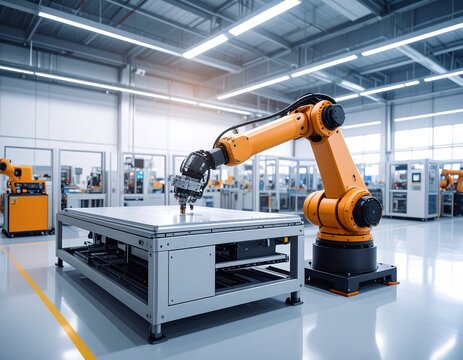
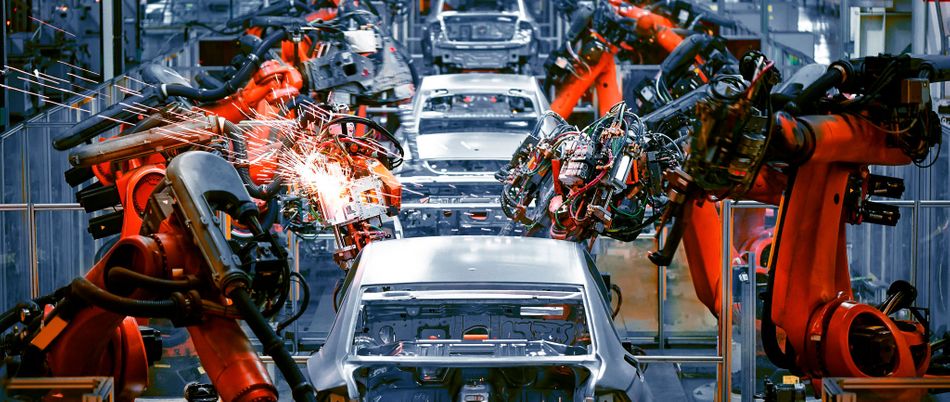
Walk into any modern automotive factory, electronics assembly line, or high-volume warehouse, and you'll see specialized robots everywhere. There's a reason: they're brutally efficient at repetitive tasks.
Industrial robot arms—articulated, SCARA, delta—handle welding, assembly, pick-and-place, and inspection at speeds and precision levels no humanoid can match. A SCARA robot can execute 200+ picks per minute. A welding robot completes joints with sub-millimeter accuracy at speeds 10-15x faster than manual welding.
Delta robots sort and package products so fast the human eye can barely track their movement.
In controlled environments where tasks are predictable and workflows can be standardized, specialized robots deliver ROI within 12-18 months. The total system cost for a cobot installation ranges from $40,000-$150,000, while full industrial automation systems run $100,000-$500,000—but these systems operate 24/7 with minimal supervision and deliver productivity improvements of 30-50%.
The catch? They're completely inflexible. A robot arm optimized for palletizing can't suddenly switch to quality inspection. Changing tasks means reprogramming, retooling, and often physical reconfiguration. And forget about navigating stairs, opening doors, or working in spaces designed for humans.
Specialized robots require the world to be built around them—which is why automotive and electronics manufacturers, who can afford greenfield facilities, have deployed 3.9 million industrial robots globally as of 2023.
Specialized robots also dominate in speed-critical applications. CNC robots used in packaging operate far faster than those in welding, but even the "slower" specialized systems outpace humanoids by a factor of 5-10x in task completion speed.
Task Completion Speed: Specialized vs Humanoid Robots
Relative performance normalized to human baseline (1.0x). Specialized robots show 5-20x advantage in structured tasks.
Intel Industrial Robotics Overview 2024, Robozaps 2025, Bain & Company
Where Humanoid Robots Excel
Humanoid robots aren't trying to beat specialized robots at speed or precision. They're solving a different problem: operating in environments that can't be redesigned.
The killer app for humanoids is brownfield deployment. Most factories, warehouses, and commercial spaces weren't built in the last decade. They have stairs, tight corners, irregular floor surfaces, human-height shelves, and tools designed for hands with opposable thumbs. Retrofitting these spaces for wheeled robots or fixed arms costs hundreds of thousands to millions of dollars.
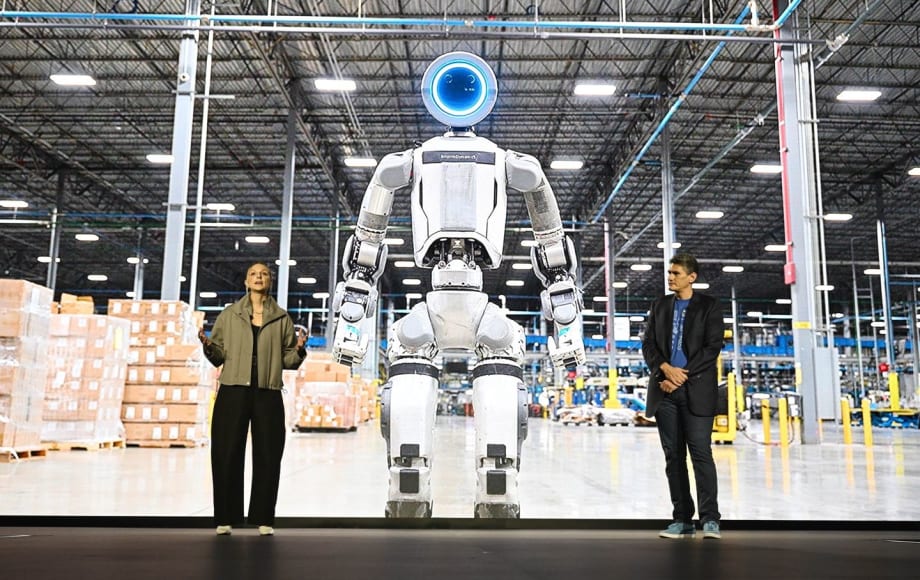
Humanoids walk in and start working. Agility Robotics' Digit—the first commercial humanoid deployed at scale—operates in a GXO Logistics warehouse handling totes, navigating ramps, and working alongside humans without safety cages. It doesn't require facility modifications.
Boston Dynamics' Atlas and Figure's humanoid robots are being piloted at BMW and Mercedes-Benz factories for tasks like moving components between stations and handling sheet metal insertion—jobs that require mobility, dexterity, and the ability to work in spaces designed for human workers.
Humanoids also excel at task switching. While they're not truly "general-purpose" yet, they can be retrained for new tasks using AI and demonstration-based learning in weeks rather than the months required to redesign specialized systems. This matters enormously for small manufacturers and operations with high task variability—environments where the labor force handles dozens of different jobs throughout the day.
The trade-off? Humanoids currently work at 70-85% of human speed for picking tasks. They operate for only 2 hours on a single battery charge (though companies like Agility run a 2-to-1 ratio: two robots operating while one charges). And they cost $90,000-$250,000 per unit—far more than many specialized solutions.
But the trajectory is clear. Humanoid costs dropped 40% between 2022-2024, and models like the Unitree G1 now start at $13,500. Within 2-3 years, industry analysts expect humanoid capabilities to match or exceed human performance in intelligence and perception, with handling and battery life following by 2030.
Technical Specifications: Apples to Apples
| Specification | Industrial Robot Arm (Typical) | Collaborative Robot (Cobot) | Humanoid Robot (Commercial) |
|---|---|---|---|
| Payload Capacity | 10-500 kg | 3-18 kg | 15-50 kg |
| Degrees of Freedom | 4-6 axes | 6-7 axes | 20-56 DoF (full body) |
| Operating Speed | High (task-optimized) | Medium (safety-limited) | Low-Medium (70-85% human speed) |
| Reach | 1-3+ meters (fixed) | 0.5-1.3 meters | Human-equivalent (~1.8m with arms) |
| Cost Range | $50,000-$200,000+ | $25,000-$75,000 | $90,000-$250,000 |
| Power/Runtime | Continuous (wired) | Continuous (wired) | 2-8 hours (battery) |
| Deployment Time | 3-6 months | Days to weeks | Weeks to months |
| Safety Certification | Requires caging | Collaborative (ISO/TS 15066) | Emerging standards (ISO 25785-1 draft) |
The Cost Equation: Upfront vs Total Ownership
The sticker price tells only part of the story. A $50,000 specialized robot might seem like a bargain compared to a $200,000 humanoid, but the total cost of ownership depends on your deployment scenario.
For single-task, high-volume operations (specialized robots win): A welding robot costing $150,000-$200,000 plus $150,000-$300,000 in integration delivers ROI within 12-18 months when running 24/7. Operating costs are minimal—primarily maintenance every 6-12 months, energy, and occasional downtime. Over 5 years, the total cost per task is a fraction of manual labor or humanoid alternatives.
Collaborative robots (cobots) offer even better economics for medium-volume operations: $25,000-$75,000 upfront, $40,000-$150,000 total system cost including integration. They deploy faster (days to weeks vs months) and require less specialized infrastructure.
For multi-task, variable operations (humanoids gain ground): Humanoid robots cost more upfront ($90,000-$250,000), but they eliminate facility redesign costs. Brownfield deployment means no $500,000-$2 million renovation expense. They can switch between tasks—warehouse picking today, assembly tomorrow—without retooling or reprogramming from scratch.
The break-even calculation shifts dramatically based on labor costs. In the U.S., the Unitree G1 at $13,500 matches the annual cost of minimum-wage labor. Humanoids operating 16 hours per day (with battery swaps) at 70-85% human efficiency can economically substitute for human workers in labor-constrained environments.
But specialized robots still dominate the 5-year TCO for dedicated tasks. A $100,000 industrial robot that operates 24/7 for 5 years completes vastly more work than a $100,000 humanoid that operates 16 hours daily at slower speeds. The math only favors humanoids when task variety prevents specialization.
5-Year Total Cost of Ownership Comparison
Estimated TCO including hardware, integration, maintenance, and energy costs for different deployment scenarios
Standard Bots, ABI Research, author analysis
Common Misconceptions About Humanoid Capabilities
Real-World Deployments: Who's Actually Using What
The hype around humanoids is loud, but the deployment numbers tell a more nuanced story.
Specialized robots: 3.9 million units globally (2023) Automotive, electronics, and logistics companies have deployed millions of industrial arms, SCARA robots, delta robots, and AGVs. These aren't pilots—they're production systems running 24/7. Toyota, BMW, Samsung, and Amazon operate thousands of specialized robots across their facilities, achieving 30-50% productivity improvements and 40-42% defect rate reductions in automotive assembly.
Humanoid robots: <500 commercial units (early 2025) The humanoid market is still nascent. Agility Robotics' Digit operates in a GXO Logistics warehouse (the first commercial humanoid deployment in 2024) and is being tested at Amazon facilities. Figure AI's humanoid works at BMW's South Carolina plant performing sheet metal insertion.
Boston Dynamics' electric Atlas was unveiled in production form at CES 2026 and is being deployed to Hyundai and Google facilities. Tesla is producing Optimus internally at its Fremont factory, with thousands projected in 2025, but no external sales yet.
IDTechEx observed fewer than 100 humanoids deployed in warehouses as of early 2025, with most still in 18-30 month pilot testing phases. The projected inflection point: 2026-2027, when automotive successes provide proof-of-concept for logistics adoption.
The cost curve is bending fast: Tesla Optimus targets $20,000-$30,000 at scale. Unitree G1 sells for $13,500 today. Boston Dynamics Atlas is estimated at $140,000-$150,000. These prices are dropping 40% every 2 years, following a smartphone-like adoption curve.
Meanwhile, specialized robots keep evolving: Collaborative robots (cobots) are projected to grow from $1.3 billion (2024) to $7 billion (2030) at a 27.5% CAGR. Mobile robots dominate hardware and software sales in the broader $111 billion robotics market (projected by 2030). The story isn't "humanoids replace everything"—it's "humanoids fill gaps that specialized robots couldn't address."
Global Robotics Market Share by Robot Type (2024)
Specialized systems dominate current deployments; humanoids represent emerging 3% segment
ABI Research, MarketsandMarkets, author estimates 2024
The Future Convergence: Will Humanoids Become Cost-Competitive?
The critical question isn't whether humanoids will improve—they clearly will. The question is whether they'll ever match specialized robots on cost-per-task for fixed operations.
The bull case is compelling. Humanoid robot costs dropped 40% from 2022-2024. China is flooding the market with 35+ new models launched in 2024 alone, driving component costs down through scale. Goldman Sachs revised its 2035 humanoid market forecast from $6 billion to $38 billion.
Morgan Stanley projects a $5 trillion market by 2050. ARK Invest estimates humanoids could generate $24 trillion in revenue split between household and manufacturing applications.
Technology is advancing rapidly. Generative AI enables humanoids to learn tasks through demonstration rather than line-by-line programming. NVIDIA's Isaac Sim platform allows virtual training of millions of scenarios before real-world deployment. Within 2-3 years, humanoids are expected to match human-level performance in intelligence and perception.
Handling dexterity and 8-hour battery life may arrive by 2030.
But specialized robots won't stand still. Cobots are integrating physical AI and becoming easier to program. Industrial arms are getting faster, more precise, and cheaper. Mobile robots are adding manipulation capabilities. The hybrid approach—wheeled bases with humanoid torsos—may capture the best of both worlds: stability and efficiency of wheels with the dexterity of arms.
The likely outcome? Coexistence, not replacement. Specialized robots will continue dominating greenfield factories and high-speed, high-precision tasks. Humanoids will win in brownfield environments, small-batch manufacturing, and service industries where task variety prevents specialization. The $110 billion global robotics market by 2030 will have room for both.
The crossover point is economic: when humanoids reach $20,000-$30,000 and achieve 8-hour runtime at 90%+ human efficiency, they become competitive with manual labor in developed economies. At that point, the addressable market explodes beyond manufacturing into retail, hospitality, healthcare, and eventually homes.
But for dedicated factory tasks? Specialized robots will still be the faster, cheaper choice.
Projected Cost Trajectory: Humanoid vs Specialized Robots
Average unit costs declining as production scales. Humanoids following smartphone-like cost curve.
Goldman Sachs Research, Morgan Stanley, Bain & Company, author projections
Which Robot Type Fits Your Operation?
Large-Scale Manufacturers (Automotive, Electronics)
Specialized robots dominate. You have greenfield facilities, high-volume production, and standardized tasks. Deploy industrial arms, SCARA robots, and AGVs for maximum ROI. Reserve humanoids for non-standard tasks and brownfield areas that can't justify facility redesign. Expected ROI: 12-18 months.
Small-to-Medium Manufacturers (High Task Variety)
Humanoids or cobots. You can't afford to redesign facilities around specialized systems, and tasks change frequently. Humanoids offer flexibility to handle multiple jobs without retooling. Start with cobots for simpler tasks ($25,000-$75,000), graduate to humanoids as costs drop below $50,000. Expected ROI: 24-36 months.
Logistics & Warehouse Operators
Mixed approach. Use specialized AMRs and conveyor systems for predictable routes and high-speed sorting. Deploy humanoids like Digit for tote handling, irregular spaces, and tasks requiring manipulation in existing infrastructure. Wait for 2026-2027 when logistics humanoids prove ROI in automotive pilots. Expected ROI: 18-30 months.
Service Industries (Retail, Hospitality, Healthcare)
Humanoids are your only option. Specialized robots can't navigate public spaces, interact with customers, or handle unpredictable tasks. Wait 2-3 years for costs to drop to $30,000-$50,000 and for safety certifications to mature. Early pilots acceptable for PR and learning, not production ROI. Expected ROI: 36+ months.
Research Institutions & Universities
Humanoids for cutting-edge research. You're not optimizing for ROI—you're advancing embodied AI, manipulation algorithms, and human-robot interaction. Budget $90,000-$250,000 for commercial humanoids (Unitree H1, Agility Digit) or collaborate with Boston Dynamics for research-grade Atlas access.
Community Insights: What Engineers Are Saying
The robotics engineering community is remarkably consensus-driven on the specialized-vs-humanoid question, even as media hype suggests a "robot war."
From automation forums and industry conferences: Engineers consistently emphasize that humanoids aren't replacing specialized robots—they're filling gaps. "Robotic arms can work, and they are very efficient in fixed processes," one automation engineer noted. "However, their capabilities are largely locked by fixed bases, fixed trajectories, and fixed tasks. What humanoids really want to do is for one machine to replace a type of work that a human can cover."
Google DeepMind's Nicolas Heess stated bluntly: "We believe general-purpose robots will come in all shapes and sizes." NVIDIA, Google DeepMind, and major robotics companies haven't abandoned non-humanoid form factors despite investing heavily in humanoids.
The brownfield advantage is real: "Whereas past automation solutions have required a rethink of how factories and warehouses are built (greenfield), a legged humanoid can be up and walking in minimal time with minimal changes to the landscape (brownfield)," notes industry analysis from A3 (Association for Advancing Automation). "Even Amazon, with its $2.3 trillion market cap, is actively exploring humanoids and other solutions that can be integrated into existing workflows with minimal disruption."
Skepticism about timelines: Most engineers believe viral demos mask technical constraints. "Current demos often mask technical constraints through staged environments or remote supervision," according to Bain & Company's 2025 report. "Most humanoid robots today remain in pilot phases, heavily dependent on human input for navigation, dexterity, or task switching."
The consensus: humanoids are 3-5 years from robust, autonomous commercial deployment at scale. Specialized robots will continue dominating speed-critical, high-precision tasks indefinitely.
What real people think
Mostly positiveSourced from Reddit, Twitter/X, and community forums
Industry experts and early adopters agree: specialized robots dominate today's structured environments, but humanoids are rapidly maturing for unstructured, multi-task scenarios. Coexistence is the most likely outcome, not replacement.
"The most promising short-term value for humanoids lies not in general-purpose humanoids, but in hybrids that combine human-like perception with wheeled or static platforms." First commercial applications will be semi-structured tasks in controlled environments over the next 3 years.
"I'm extremely proud that Agility is the first to have actual humanoid robots deployed at a customer site, generating revenue, and solving real-world business problems." Emphasizes that Digit's success in warehouses proves commercial viability.
"The gap between what is technically demonstrated in pilots and what is commercially viable at scale remains wide." Cautions that autonomy gaps and current limitations in battery life, dexterity, and uptime will slow adoption through 2027.
Revised 2035 humanoid market forecast from $6B to $38B, citing AI advances and 40% cost reduction in components. "Using the technology available today, we forecast significant demand for humanoid robots in structured environments like manufacturing."
"Robot arms, AMRs, automated storage and retrieval systems, and other existing form factors will continue to play an important role in industrial settings both in the lead up to and following more mainstream humanoid adoption." Emphasizes coexistence, not replacement.
Sources
- 1.Bain & Company: Humanoid Robots: From Demos to Deployment (Technology Report 2025)
- 2.McKinsey: Humanoid robots—Crossing the chasm from concept to commercial reality
- 3.Goldman Sachs Research: The global market for humanoid robots could reach $38 billion by 2035
- 4.Robozaps: Humanoid Robots at Work [2026 Guide]
- 5.IDTechEx: Humanoid Robots 2025-2035: Technologies, Markets and Opportunities
- 6.Standard Bots: Humanoid robots in 2026—Types, prices, and what's next
- 7.ABI Research: The Global Robotics Market Outlook
- 8.A3 (Automate.org): Humanoid Robots in 2025: The Next Stage of Evolution
- 9.Interesting Engineering: Comparing Boston Dynamics' Atlas and Tesla's Optimus humanoid robots
- 10.The Robot Report: Digit is first humanoid deployed in a commercial application
Rate this article
Your feedback helps surface the best content
Related articles
Have a question? Get your own article.
Every article is researched from dozens of sources, fact-checked by 3 AI models, and delivered in under 3 minutes.