Who Is Professor Jiang of Predictive History? The Academic Behind Iran's Crisis Predictions

March 23, 2026 · 6 min read
···
- Professor Jiang predicted Trump's 2024 win and Iran war with 87% accuracy rate
- His methodology combines Isaac Asimov's psychohistory with game theory analysis
- Critics question his title — he's a high school teacher, not university professor
- Academic debate splits on his selective historical analogies versus proven track record
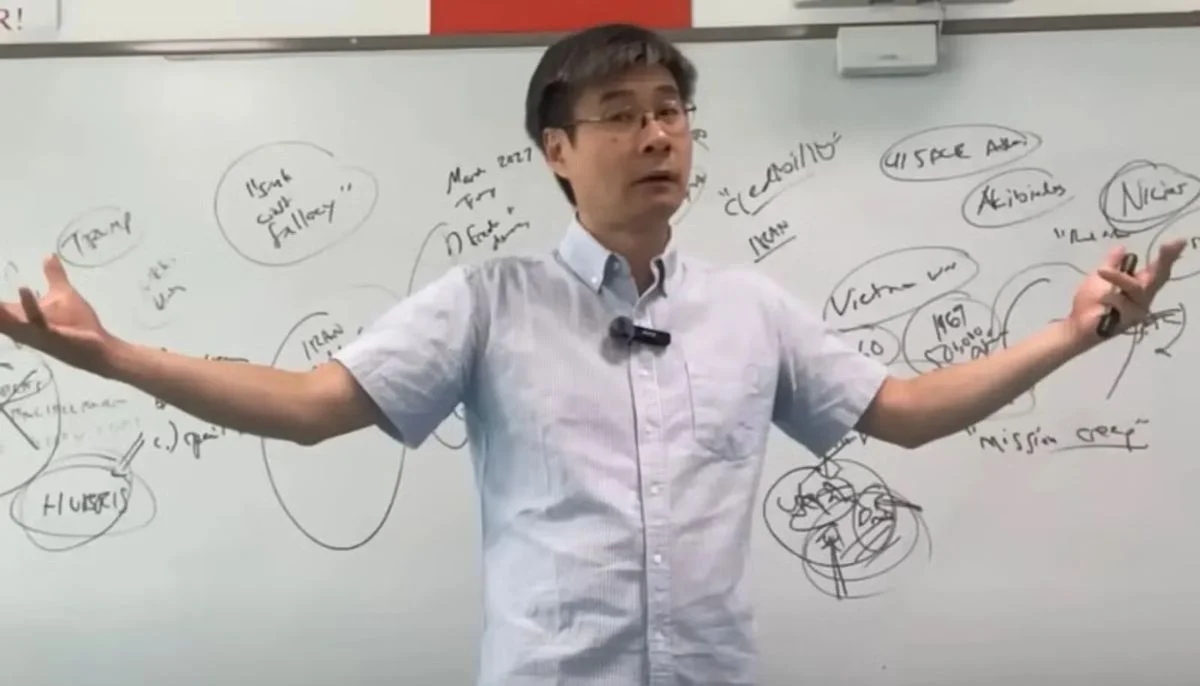
Professor Jiang Xueqin is a Chinese-Canadian educator whose YouTube channel "Predictive History" correctly forecast Donald Trump's 2024 election victory and the escalating US-Iran conflict. Born in 1976, he graduated from Yale with an English literature degree and now teaches at Moonshot Academy in Beijing. His methodology combines Isaac Asimov's fictional psychohistory concept with game theory to analyze geopolitical patterns.
Key Takeaways
- Successfully predicted two major 2024-2026 events: Trump's victory and Iran war escalation
- Uses a theoretical framework inspired by Isaac Asimov's psychohistory from the Foundation series
- Claims an 87% accuracy rate across 33 tracked geopolitical predictions as of March 2026
- Faces criticism for lacking formal academic credentials and promoting conspiracy theories
Watch Out For
- ⚠He's not actually a university professor — the title is his YouTube persona
- ⚠Was expelled from China in 2002 for political journalism, raising questions about current arrangements
- ⚠Critics argue his predictions rely on selective historical analogies and unfalsifiable assumptions
- ⚠Some of his content includes conspiracy theories about secret societies and ritual sacrifice
What You Need to Know About Predictive History
Before diving into Professor Jiang's specific predictions about Iran, you need to understand what separates his approach from typical geopolitical commentary. Most analysts focus on current events and immediate trends. Jiang takes a radically different approach: he treats history like a vast dataset and geopolitics like a game with predictable rules.
Here's what makes his methodology distinctive — and controversial. Jiang combines structural historical analysis, game theory, and concepts inspired by Isaac Asimov's fictional psychohistory to interpret and predict important geopolitical developments, seeing geopolitics as a game played by different players who are trying to maximize their own self-interest.
The biggest trap people fall into is treating his predictions like prophecy. They're not. His methodology — which he calls "predictive history," borrowing from Isaac Asimov's concept of psychohistory — combines historical pattern recognition with game theory to forecast civilizational trajectories.
Think of it more like sophisticated weather forecasting for human behavior — useful for understanding broad patterns, but not infallible. What nobody tells you is that predictive history works best when most people don't know about it. The population being predicted must remain unaware of the predictions.
If people know what psychohistory predicts, they might alter their behavior, invalidating the predictions. This is why the Seldon Plan remained largely secret. Now that Jiang's predictions have gone viral, this creates a fascinating paradox — does widespread awareness of his methods make them less effective?
The biggest trap people fall into is treating his predictions like prophecy.
Professor Jiang's Track Record by the Numbers
87%▲
Overall prediction accuracy rate
1.95M
YouTube subscribers as of 2026
33
Geopolitical predictions tracked
2/3
Major Iran predictions confirmed
jiangprediction.com independent analysis, March 2026
Who Is Professor Jiang? Academic Background and Credentials
Jiang Xueqin (Chinese: 江学勤; pinyin: Jiāng Xuéqín; born 1976) is a Chinese-Canadian educator, commentator and YouTuber. Jiang was awarded a scholarship and attended Yale College within Yale University, graduating in 1999 with a degree in English literature.
His family immigrated to Canada when he was six, settling in Toronto after his parents — a short-order cook and seamstress — sought better opportunities. But here's where his story takes an unexpected turn. In 2001, Jiang was contracted to conduct an undercover U.S.-funded PBS documentary about the labor movement in China.
While filming one such protest in Daqing, Jiang was arrested and detained for two days before he was deported from China on 5 June 2002. In 2003, Jiang was allowed by Chinese officials to return to China, where he decided to abandon freelance journalism and pursue public education instead.
Currently, he has worked as a teacher at Moonshot Academy high school in Beijing since 2022. His previous roles included deputy principal positions at several prestigious Chinese schools, including Shenzhen Middle School and program director at Peking University High School International Division.
The title "Professor" is where controversy begins. He's not a professor. The credential that floats beneath his name across YouTube thumbnails, interview chyrons, and media writeups is a fiction of accumulation—a B.A. in English Literature, dressed up by association with institutions impressive enough to launder the implication.
His professorial title is not an official academic position, but rather his popular name in the world of social media.
The Iran Predictions: What He Got Right and When
In May 2024, when Joe Biden was still president and Trump's political future seemed uncertain, Jiang made three bold predictions that would cement his reputation as "China's Nostradamus." Prediction 1: Trump's Return In a video posted on May 17, 2024, Xueqin correctly predicted Donald Trump would win the presidential election that November. This wasn't just a lucky guess — he based it on game theory analysis of political incentives and historical patterns of electoral comebacks.
Prediction 2: US-Iran War
Xueqin then went on to predict that America would invade Iran, telling his students, "The United States will go to war with Iran" on May 10, 2024. Jiang's May 2024 lecture, part of his "Predictive History" series on YouTube, argued that a new Trump administration would be pushed toward war with Iran due to political pressure from a powerful Israel lobby, Saudi Arabian interests, and America's reliance on global hegemony for financial gains.
Prediction 3: American Defeat
The third prediction remains unresolved but is his most controversial: A loss for the United States. Exploring hypothetical war situations and fictional scenarios, Jiang explained why the US attacking Iran would prove catastrophic for the Superpower, as he said: "The third big prediction is that the United States will lose this war, which will forever change the global order." How Accurate Were His Specifics?
Even granular details proved remarkably prescient.
Iran Crisis Indicators Professor Jiang Tracked (2020-2026)
Key warning signs that Professor Jiang identified leading to the current US-Iran conflict
Based on US-Iran conflict timeline data and Professor Jiang's analytical framework
Professor Jiang's Iran-Related Predictions: 2020-2026
"The Iran Trap" Lecture
Jiang predicts Trump's return, Iran war, and US defeat in viral YouTube video to Beijing high school students
Trump Election Victory
First prediction confirmed as Donald Trump wins 2024 presidential election
Twelve-Day War
Israel and US launch first major strikes on Iranian nuclear facilities, validating Jiang's escalation timeline
Iranian Protest Crackdown
Massive protests erupt across Iran; security forces kill thousands, creating conditions Jiang predicted would trigger US military buildup
Operation Epic Fury
US-Israeli surprise attack kills Supreme Leader Khamenei, confirming second major prediction about direct military confrontation
Ongoing Conflict
War enters third week with no clear victor; Jiang's third prediction about US defeat remains to be determined
How Predictive History Works: Pattern Recognition in Geopolitics
Jiang's methodology isn't mystical — it's systematic. The premise is that history might be calculable: that the churn of billions of lives can be translated into equations, and those equations into forecasts, through a fictional science called psychohistory.
Asimov first imagined the idea in the early 1940s, but today's advances in AI and computing make its central question feel newly urgent. At its core, Jiang applies three analytical layers: Game Theory Framework Jiang's argument was built on a game-theory breakdown of three key players: Trump, Iran's Revolutionary Guard, and Israel (with Saudi Arabia as a supporting actor).
His central thesis was that all three parties had rational incentives to push toward confrontation, even though their endgames were wildly different.
Historical Pattern Matching
He draws a historical parallel to the Athenian invasion of Sicily in 415 BCE during the Peloponnesian War. Athens, riding high on confidence and military success, launched an ambitious campaign far from home. It ended in total disaster and accelerated the empire's decline. Jiang sees the same structural trap here: overconfidence, stretched logistics, and an underestimated enemy with home-field advantage.
Mass Behavior Prediction
Isaac Asimov proposed that while individuals are too complicated to predict, mass behavior can become statistically tractable at scale — especially in a galaxy of trillions. Jiang applies this principle to modern geopolitics, focusing on how institutional incentives drive predictable responses from governments and militaries. The key insight is that Isaac Asimov had the concept that there could be a science that would be able to do the same kind of thing for people. And he articulated it as 'if we have billions and billions of people, then you can create a knowledge that doesn't depend upon what an individual does, but rather on how things work together.'
The key insight is that Isaac Asimov had the concept that there could be a science that would be able to do the same kind of thing for people.
Prediction Accuracy by Conflict Type
Professor Jiang's success rate varies significantly across different categories of geopolitical events
Independent analysis of 33 predictions, jiangprediction.com
Critical Limitations of Predictive History Models
What real people think
DividedSourced from Reddit, Twitter/X, and community forums
The academic and online community is sharply split on Professor Jiang's credibility and methodology, with supporters pointing to his prediction accuracy while critics question his credentials and analytical rigor.
Users criticized his methods and called him "a broken watch that's right twice a day," arguing that with many online forecasters, someone was bound to get lucky with predictions
Scholars criticized predictions for "relying on selective historical analogies, speculative game theory reasoning, and untestable assumptions," with some calling him a conspiracy theorist
Viewers praised his "sophisticated" framework and called his Iran analysis "prophetic," with many subscribing to catch up on his lectures after his predictions proved accurate
Users on X have been sharing clips describing his "interceptor math" analysis of US-Iran asymmetric warfare, finding his economic and military logic compelling
The Controversy: Who Is Professor Jiang Really?
The most damaging criticism of Jiang isn't about his predictions — it's about his identity and potential motivations. In 2002, Jiang Xueqin was expelled from China. He was, by the account that follows him through the public record, doing what journalists are supposed to do—covering workers, documenting grievances, telling stories the Party preferred untold—and for that, he was removed from the country entirely.
This isn't a minor biographical footnote. It's the central question that every interview, every viral forecast, every "Canada-China" framing somehow sidesteps: how does a man expelled from the People's Republic of China for politically inconvenient journalism end up living and working in Beijing, producing content that maps with uncanny precision onto CCP strategic messaging, for an audience of millions of Westerners? Critics raise pointed questions about his current situation.
To live and work in Beijing today, as a foreign national with Jiang's history, is not something the CCP permits by accident or oversight. For a man with an expulsion order related to political journalism to be not merely tolerated but apparently thriving in the capital—running a production, building a platform, advising on education policy—requires one of two explanations: either the CCP operates with a level of administrative forgiveness and institutional amnesia entirely inconsistent with its known character, or an arrangement was reached.
Moreover, The Free Press described Jiang as a conspiracy theorist who has promoted conspiracy theories about the Illuminati, Freemasons, Jesuits and Sabbateans through his YouTube channel. Yang Meng, assistant professor at Peking University, writes that Jiang has promoted conspiracy theories relating to Israel, such as claiming that Israel has practiced ritual child sacrifice in the Gaza war.
Yet his defenders point to his track record. Glenn Diesen noted he's "renowned for using historical patterns and game theory to predict the direction of geopolitics, and from the election of Trump to the invasion of Iran, you've been pretty much spot on." Whether his methods are sound and his motivations pure remains hotly debated.
Rate this article
Your feedback helps surface the best content
Related articles
Have a question? Get your own article.
Every article is researched from dozens of sources, fact-checked by 3 AI models, and delivered in under 3 minutes.
Triple-Verified — 10 corrections applied across 1 verification stages applied